The contractor walked through your commercial kitchen and said, “You need urethane cement, not epoxy.” You nodded, but you probably didn’t know exactly why — or why the quote just jumped from $5 a square foot to $12.
Here’s the real answer: standard epoxy is a rigid, brittle polymer. Heat it rapidly — with steam cleaning, with hot water from a floor mop, with condensation dripping from a commercial dishwasher — and it expands and contracts differently than the concrete underneath it. Do that enough times and it cracks, lifts, and delaminates. In a commercial kitchen, that’s not a cosmetic problem. It’s a harbor for bacteria, a health code violation, and an expensive emergency repair during your busiest week.
Urethane cement doesn’t do that. It was designed not to.
What Urethane Cement Actually Is
Urethane cement (also called cementitious urethane or polymer-modified cementitious coating) is a hybrid system: it combines the compressive strength of Portland cement with the chemical resistance and flexibility of polyurethane resin. The result is a floor that can handle:
- Thermal shock — rapid temperature swings from -20°F freezer runoff to +212°F steam cleaning without cracking
- Chemical resistance — acids, alkalis, fats, oils, cleaning agents, and alcohol (critical for breweries and distilleries)
- Steam cleaning — the nemesis of standard epoxy; urethane cement is unaffected
- Continuous wet conditions — drains, floor washing, condensation drip zones
The USDA and FDA don’t specify a single flooring product by name for food facilities, but their guidance on seamless, impervious flooring systems that tolerate cleaning at high temperatures points directly at urethane cement in demanding wet areas. Most third-party food safety auditors (SQF, BRC, FSSC 22000) flag deteriorated or porous flooring as a critical finding — another reason food manufacturers take floor specs seriously.
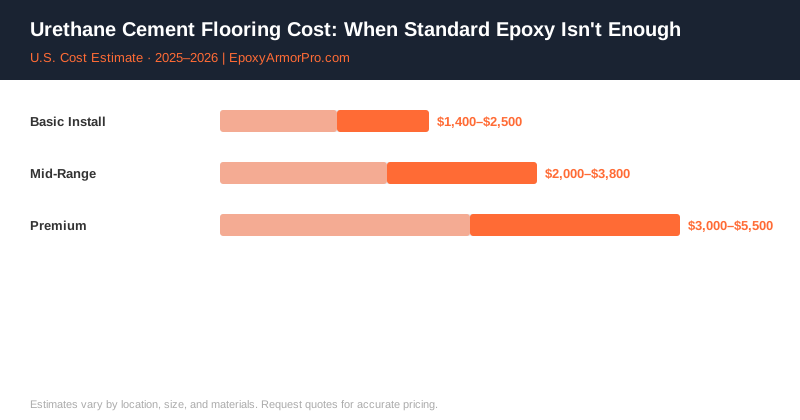
Cost Breakdown for 2026
Urethane cement is a specialized product, and the labor is more demanding than standard epoxy. You won’t find it at big-box stores or in the portfolio of every general contractor.
| Facility Type | Cost per Sq Ft (Installed) | Typical System Thickness |
|---|---|---|
| Commercial kitchen (restaurant) | $9–$13 | 3–6mm troweled |
| Food processing / manufacturing | $10–$15 | 6–9mm heavy-duty |
| Brewery / distillery | $10–$14 | 6–9mm, acid-tolerant formulation |
| Cold storage / walk-in freezer | $8–$12 | 3–6mm, thermal shock rated |
| Institutional kitchen (hospital, school) | $8–$12 | 3–6mm with anti-slip broadcast |
| Light industrial (labs, pharma) | $9–$13 | 3–6mm, chemical resistant |
The thickness matters. A 3mm system handles restaurant traffic. A 6–9mm troweled mortar system is what food processors with forklifts, pallet jacks, and hose-down cleaning protocols actually need. Thicker systems cost more in material and labor but also last significantly longer under abuse.
Why It Costs More Than Standard Epoxy
The price gap between standard commercial epoxy ($3–$7/sq ft) and urethane cement ($8–$15/sq ft) comes from several real factors:
Material cost: Urethane cement formulations use higher-grade resins and require precise mixing ratios. The material itself costs roughly 2–3x more per gallon than standard epoxy.
Application difficulty: Urethane cement is trowel-applied, not roller-applied. It requires skilled applicators who understand pot life, temperature sensitivity, and the correct trowel technique for achieving uniform thickness. Bad application leads to surface voids and weak spots.
Specialized surface prep: Concrete must be shot-blasted to achieve the surface profile required for urethane cement adhesion — typically CSP 4–5 per ICRI guidelines. That’s more aggressive than the CSP 2–3 typically needed for epoxy, which takes more time and equipment.
Limited contractor pool: Not every epoxy contractor installs urethane cement. Fewer qualified installers means less price competition and longer lead times.
Urethane Cement vs. Standard Epoxy: Side-by-Side
| Factor | Standard Epoxy | Urethane Cement |
|---|---|---|
| Installed cost | $3–$7/sq ft | $8–$15/sq ft |
| Thermal shock resistance | Poor | Excellent |
| Steam cleaning tolerance | Poor | Excellent |
| Chemical resistance | Good | Excellent |
| Flexibility | Rigid | Flexible (moves with slab) |
| Best application | Garages, warehouses, showrooms | Commercial kitchens, food processing, breweries |
| Typical lifespan (commercial) | 5–10 years | 10–20 years |
If your facility doesn’t involve steam cleaning, hot liquids, rapid temperature changes, or aggressive chemical exposure, standard epoxy is probably fine — and significantly cheaper. The garage epoxy guide and DIY vs. professional comparison cover those scenarios in detail.
But if any of those conditions apply, you’re not overpaying by choosing urethane cement. You’re avoiding an emergency re-coat in year three.
The Installation Process
Urethane cement installation follows a more intensive sequence than standard epoxy:
- Shot blasting — Opens the concrete profile to CSP 4–5 for maximum adhesion
- Crack and joint repair — All cracks and control joints addressed before coating
- Moisture testing — Urethane cement tolerates higher moisture vapor transmission than epoxy (up to 8–10 lbs per 1,000 sq ft per 24 hours in some formulations), but testing is still required
- Priming — A polyurethane or epoxy primer goes down to seal the surface
- Trowel application — The urethane cement mortar is mixed and applied by hand trowel, typically in one or two coats depending on system thickness
- Anti-slip broadcast (if specified) — Aluminum oxide or quartz broadcast into the wet surface
- Sealer/topcoat — Optional but common; improves chemical resistance and cleanability
- Curing — Typically 24–48 hours to foot traffic, 5–7 days before heavy equipment
Finding the Right Contractor
Not every epoxy contractor works with urethane cement. When vetting contractors for this type of project, ask specifically:
- Have you installed urethane cement in a food service environment before? Can you provide references?
- What formulation do you use, and what’s its rated thermal shock tolerance?
- Does your quote include integral cove base, and how high does it run up the wall?
- What surface prep method do you use — shot blasting or grinding? (Shot blasting is preferred for this application.)
- What warranty do you offer on adhesion?
A contractor who’s installed two or three garage floors isn’t the right call for a commercial kitchen urethane cement job. The product, the prep, and the stakes are all different.
The premium over standard epoxy is real. But in a commercial kitchen, food processing plant, or brewery where your floor has to survive what you throw at it every day, urethane cement is often the only system that makes it past year five without a failure.
Contractor Referral Disclaimer: EpoxyArmorPro is a contractor referral and cost information service, not a licensed flooring contractor. We connect consumers with independent, licensed, and insured contractors. We do not perform any flooring work directly. Cost estimates are averages based on market data and vary by location, project size, materials, and contractor. Always verify contractor licensing and insurance before hiring. Individual quotes may differ from estimates shown.