42% of all electronic component failures in manufacturing are caused by electrostatic discharge, according to the ESD Association — and most of those failures are invisible at the time they happen. A component that’s been zapped by static doesn’t fail immediately; it works, ships, and fails in the customer’s product six months later.
That’s why ESD flooring isn’t a compliance checkbox in electronics manufacturing, server rooms, and medical device facilities. It’s damage prevention, measured in defect rates and warranty claims.
Here’s what that floor actually costs and what goes into it.
What ESD Epoxy Flooring Actually Costs
Standard commercial epoxy runs $3–$7 per square foot installed. ESD systems cost more — significantly more — because the product, the installation, and the verification process are all more demanding.
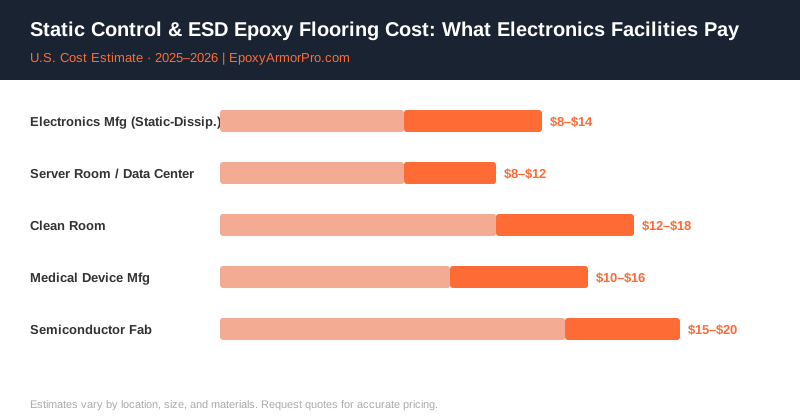
| Facility Type | ESD System Type | Cost per Sq Ft (Installed) |
|---|---|---|
| Electronics manufacturing | Static-dissipative epoxy | $8–$14 |
| Server room / data center | Static-dissipative epoxy | $8–$12 |
| Clean room (Class 10,000 and below) | Conductive or static-dissipative | $12–$18 |
| Medical device manufacturing | Static-dissipative, FDA-compatible | $10–$16 |
| Semiconductor fab | Conductive epoxy or specialty system | $15–$20+ |
| Explosive/flammable materials area | Conductive (NFPA 77 requirement) | $12–$20 |
The cost range is wide because the specification matters enormously. A server room that hosts internal IT infrastructure has different compliance requirements than a Class 1000 cleanroom manufacturing cardiac pacemaker components. Those differences show up in the floor spec and, consequently, in the price.
Conductive vs. Static-Dissipative: Which Do You Need?
These terms are often used interchangeably in casual conversation, but they’re technically distinct categories with different performance requirements under ANSI/ESD S20.20, the primary US standard for electrostatic discharge control programs.
Conductive flooring: Surface resistance of 1x10^4 to less than 1x10^6 ohms (10,000 to 999,999 ohms). Dissipates charge very rapidly. Required in environments where even brief static events are unacceptable — certain semiconductor manufacturing, explosive materials handling, and some medical device applications.
Static-dissipative flooring: Surface resistance of 1x10^6 to less than 1x10^9 ohms (1 million to 999 million ohms). Dissipates charge more gradually but still safely and reliably. Appropriate for most electronics assembly, PCB manufacturing, server rooms, and general ESD-controlled environments.
Most electronics manufacturing facilities need static-dissipative flooring, not conductive. Unless your process specifically requires conductive, the static-dissipative system gives you ANSI/ESD S20.20 compliance at a lower installed cost.
What’s in an ESD Epoxy System
Unlike standard epoxy, which gets its performance from the resin alone, an ESD epoxy system integrates several components:
Conductive additive in the coating: Carbon black powder, graphite compounds, or metal oxide particles are dispersed in the epoxy matrix at precisely controlled concentrations. Too little and resistance is too high; too much and the floor is too conductive. The additive mix is what drives the higher material cost relative to standard epoxy.
Copper grounding grid: A network of copper foil tape or conductive copper mesh is installed on the prepared concrete surface before the epoxy coating. The grid connects the floor to a facility ground point, providing a continuous path for static charge to dissipate to ground. The copper grid and its installation add $1–$3 per square foot to the total cost.
Ground connection hardware: Typically a copper ground rod or connection to the building’s electrical grounding system. Some facilities use multiple ground connection points in large spaces.
Primer layer: A conductive or static-dissipative primer ensures consistent electrical continuity between the concrete substrate and the finished coating.
Topcoat: Optional but common. A static-dissipative polyurethane or polyaspartic topcoat improves wear resistance while maintaining the electrical properties of the system.
The Testing Requirement
This is where ESD flooring differs from every other epoxy type: it has to be electrically verified after installation.
ANSI/ESD STM7.1 specifies the test methodology — a calibrated ohmmeter with 5-pound electrodes placed at measured intervals across the floor surface. The test measures point-to-point resistance and resistance to ground. Results must fall within the specified range for the system type (conductive or static-dissipative) and must be documented.
Initial testing is typically performed by the installing contractor immediately after cure. Results are provided in a written test report that the facility retains for compliance records. Many facilities also perform periodic re-testing (annually or bi-annually) to confirm the floor maintains its properties after cleaning, traffic wear, and any maintenance work.
The test equipment, calibration records, and documentation are all part of a compliant installation. If a contractor quotes you ESD flooring without mentioning testing, ask specifically — it should be included.
| Component | What It Adds to Cost |
|---|---|
| Conductive additive in epoxy | $1–$3/sq ft (material premium) |
| Copper grounding grid installation | $1–$3/sq ft |
| Ground connection hardware | $200–$800 per connection point |
| Post-installation resistance testing | $500–$1,500 per test session (often included) |
| Compliance documentation package | Usually included in qualified contractor’s quote |
ESD vs. Standard Commercial Epoxy: The True Cost of Skipping It
Standard commercial epoxy in an electronics facility costs $3–$7 per square foot — roughly half the ESD system cost. Some facility managers make the case that ESD flooring is optional if other controls (grounding straps, humidity control, packaging) are in place.
That’s technically defensible in low-sensitivity environments. But the ESD Association’s data suggests that in electronics assembly environments without floor-based static control, 8–33% of failures that appear mechanical have an underlying ESD cause. Those are warranty returns, rework hours, and reputation costs that are much harder to quantify than a flooring invoice.
The math shifts when you account for product value. A floor that costs $12,000 more than standard epoxy for a 1,500-square-foot electronics assembly area is justified by preventing a handful of field failures on $500 assemblies.
Finding a Qualified ESD Flooring Contractor
Not every commercial epoxy contractor handles ESD work. This is a specialty that requires:
- Knowledge of ANSI/ESD S20.20 and the specific compliance requirements for your application
- Experience with copper grid installation techniques
- Calibrated electrical testing equipment (ohmmeter, per ANSI/ESD STM7.1)
- Ability to provide a written test report with documented results
When vetting contractors for ESD work, ask:
- Are you familiar with ANSI/ESD S20.20, and can you design a system to that standard?
- What grounding grid configuration do you use?
- Do you include post-installation resistance testing and a written test report?
- Can you provide references from electronics manufacturing or cleanroom installations?
- What’s your warranty, and does it cover maintaining resistance values within spec?
A contractor who answers these fluently has done this before. One who needs to look up what S20.20 means hasn’t.
For context on how ESD flooring compares to standard commercial and industrial systems, see the commercial epoxy flooring cost breakdown and the industrial epoxy flooring guide.
The cost premium for a properly specified and installed ESD floor is real. So is the cost of static damage to the products you manufacture. In electronics environments, the floor isn’t an overhead expense — it’s a quality control investment.
Contractor Referral Disclaimer: EpoxyArmorPro is a contractor referral and cost information service, not a licensed flooring contractor. We connect consumers with independent, licensed, and insured contractors. We do not perform any flooring work directly. Cost estimates are averages based on market data and vary by location, project size, materials, and contractor. Always verify contractor licensing and insurance before hiring. Individual quotes may differ from estimates shown.