US highway agencies apply an estimated 23 million tons of deicing salt to roads every winter, according to the US Geological Survey. Some of that salt ends up on your driveway. A lot of it ends up on your garage floor, dissolved in the brine that drips off your car’s undercarriage.
If your garage floor is bare concrete, that brine is soaking in right now.
How Road Salt Damages Concrete
Standard rock salt (sodium chloride) and calcium chloride — the more aggressive de-icer used in colder states where temps drop below 15°F — don’t just sit on concrete. They actively damage it through two mechanisms:
Chemical Attack: Chloride Penetration
Chloride ions dissolved in water are small enough to penetrate concrete’s pore structure. Once inside, they disrupt the hydrated calcium silicate that gives concrete its strength. In reinforced concrete (most residential garage slabs have at least a wire mesh or rebar grid), chloride ions can reach the steel reinforcement and initiate corrosion. Corroding steel expands, cracking the concrete from the inside.
For unreinforced or lightly reinforced slabs, the main result is surface scaling: the top layer of concrete gradually loses cohesion and flakes off in thin sheets, exposing progressively deeper, rougher concrete.
Physical Attack: Freeze-Thaw Scaling Acceleration
This is the more destructive mechanism for typical residential garage floors. When salt is dissolved in water and that water enters concrete pores, it lowers the freezing point — creating a supercooled liquid that can freeze at temperatures well below 32°F. The number of freeze-thaw cycles the concrete experiences multiplies.
Research published in the journal Cement and Concrete Research found that concrete exposed to calcium chloride solutions showed dramatically accelerated surface scaling compared to identical concrete exposed to plain water, even at the same temperature cycling rate. The salt doesn’t just move the problem — it amplifies it.
That white, chalky, rough surface that develops on the typical northern garage floor after 10–15 years? That’s salt-accelerated scaling. It’s not normal aging — it’s accelerated degradation.
| De-icer Type | Active Chemical | Lowest Effective Temp | Concrete Aggressiveness |
|---|---|---|---|
| Rock salt | Sodium chloride (NaCl) | +15°F | Moderate |
| Calcium chloride | CaCl₂ | -25°F | High |
| Magnesium chloride | MgCl₂ | -13°F | Moderate-high |
| Potassium acetate | CH₃COOK | -76°F | Low (airport use) |
| Sand/grit | N/A | N/A | None (no chemical action) |
The Salt Belt: Which States Have the Worst Problem
The “salt belt” loosely encompasses the northern tier of states where winter road salting is heaviest: Michigan, Minnesota, Wisconsin, Illinois, Indiana, Ohio, Pennsylvania, New York, New England, and the mid-Atlantic states. USGS data shows states in this region account for the majority of annual de-icer application.
In these states, a 15-year-old uncoated garage floor often shows visible scaling, surface roughness, and in severe cases, deep pitting where the concrete surface has completely broken down. It’s not a question of whether bare concrete will degrade — it’s a question of how fast.
How Epoxy Stops Salt Damage
A properly installed epoxy coating system creates a near-impermeable barrier between the salt-laden brine on your floor and the concrete beneath it. Chloride ions can’t penetrate 100% solids epoxy — they sit on top until you mop them up.
This protection works from day one. The slab beneath stays dry, free of chloride penetration, and protected from the freeze-thaw scaling mechanism that brine accelerates.
The requirements for effective salt protection:
- 100% solids epoxy as the base coat — not water-based epoxy, which has higher porosity
- Polyaspartic or polyurethane topcoat for surface hardness and additional chemical resistance
- Complete coverage with no pinholes — voids in the coating are entry points for brine
- Proper edge sealing at the floor-wall joint, which is a common brine intrusion path
A quality 3-coat system (primer + base coat + polyaspartic topcoat) with no voids provides essentially complete salt protection.
But What About Existing Salt Damage?
If your slab already has visible scaling, the most important step is aggressive surface preparation before any coating goes down. Applying epoxy over a scaling surface doesn’t fix the damage — it seals it in. The coating will bond to the loose, scaled layer, and when that layer continues to fail, the coating fails with it.
Professional prep for salt-damaged concrete involves:
- Diamond grinding to remove the failed surface layer and expose sound concrete
- Shot blasting in severe cases to profile the concrete and remove contamination
- Crack repair and spall patching with appropriate repair mortars
- Cleaning to remove chloride salts from the surface before coating
For a full guide to fixing common concrete damage before coating, see our article on how to fix garage floor cracks.
For coated garage floors in salt-belt states:
- Rinse or mop floor when salt accumulates — don’t let brine dry and concentrate on the surface
- Use pH-neutral cleaners; avoid acid-based cleaners that can etch the topcoat
- Inspect the coating each spring for any chips, cracks, or areas where brine could reach concrete
- Patch small chips promptly; spot re-coating is far cheaper than full replacement
- Use rubber-edged snow shovels, not metal blades that can chip the coating
Timing: When to Coat a Salt-Belt Garage
Don’t coat in fall with the intention of protecting through the upcoming winter unless you have adequate lead time. A freshly coated floor needs at least 7 days of full cure before it should be exposed to heavy salt brine. Most professionals recommend 30 days before winter de-icer exposure.
The ideal timing for salt-belt homeowners is spring — May or June — after the last de-icing season. This gives the coating a full summer to cure and harden before the next winter hits. It also lets you see how the floor looks after a winter’s damage before deciding on prep requirements.
| Service | Typical Cost Range |
|---|---|
| 2-car garage epoxy + polyaspartic topcoat | $1,400–$2,800 |
| Surface grinding for scaled concrete | $0.75–$1.50/sq ft added |
| Crack and spall repair | $200–$600 depending on damage |
| Spot patching of existing coated floor | $150–$400 |
| Full recoat of failed floor | $800–$1,800 (smaller scope, concrete already prepped) |
The Math on Waiting
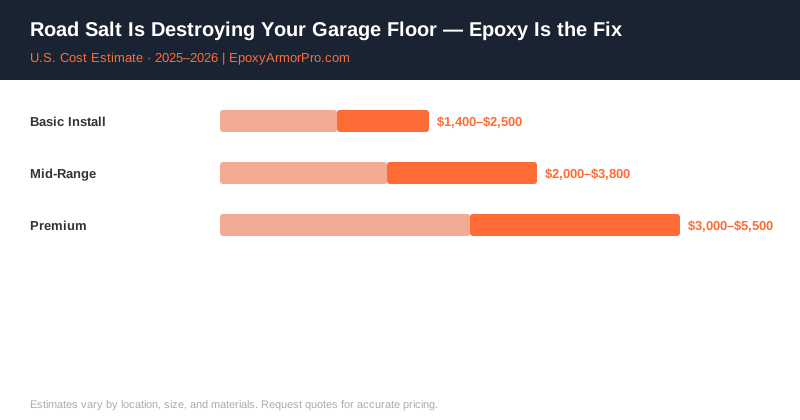
A 2-car garage floor (roughly 400 sq ft) runs $1,200–$2,400 coated. Complete concrete replacement — when scaling has progressed to the point of structural failure — runs $3,000–$8,000+ for a residential garage slab. The protection investment is a fraction of the replacement cost.
Salt damage is slow. You won’t notice it happening year by year. But look at a neighbor’s 20-year-old bare garage floor in Buffalo or Minneapolis, and the damage is obvious. The good news: if you coat now, you stop the clock.
Contractor Referral Disclaimer: EpoxyArmorPro is a contractor referral and cost information service, not a licensed flooring contractor. We connect consumers with independent, licensed, and insured contractors. We do not perform any flooring work directly. Cost estimates are averages based on market data and vary by location, project size, materials, and contractor. Always verify contractor licensing and insurance before hiring. Individual quotes may differ from estimates shown.