LVP in a garage looks beautiful on day one. Then someone parks a car on it, drips brake fluid, and drags a floor jack across it. Six months later, you’re peeling up planks.
That’s not a knock on luxury vinyl plank as a product — it’s a great floor. Just not in a garage. The mix-up happens because LVP and epoxy land in overlapping price ranges and both handle moisture, so people treat them as interchangeable. They’re not, and the right choice depends entirely on what you’re actually doing with the space.
What Each Option Costs in 2026
Prices have been relatively stable. Here’s where both options land for a professional installation:
| System | Cost per Sq Ft (Installed) | Best For |
|---|---|---|
| LVP — budget (4mm, click-lock) | $3–$5 | Finished basements, laundry rooms |
| LVP — premium (8mm, rigid core) | $5–$7 | Living spaces, light-use rooms |
| Epoxy — basic (1-coat rolled) | $3–$5 | Light residential garage |
| Epoxy — standard (2-coat system) | $5–$8 | Standard residential garage |
| Epoxy — premium (flake or metallic) | $8–$12 | Showroom garage, commercial |
| Polyaspartic topcoat system | $6–$10 | Fast-cure, UV-stable garage floors |
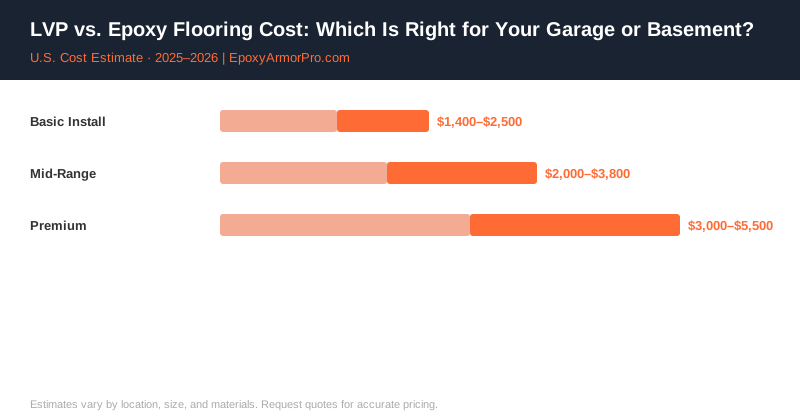
On square footage alone, a 400-square-foot garage floor might cost $2,000–$4,800 in epoxy or $1,200–$2,800 in LVP, depending on the spec. LVP is cheaper to install. But that’s not the full picture.
Durability: Where Each System Actually Holds Up
Chemical resistance: Epoxy wins, and it’s not close. Standard LVP — even premium rigid core — will discolor and soften under prolonged contact with motor oil, gasoline, brake fluid, and most automotive chemicals. Epoxy is chemically inert to most household and automotive chemicals. This matters a lot in a garage and almost not at all in a finished basement.
Impact resistance: LVP flexes slightly, which actually helps it resist cracking under point loads. Epoxy is rigid, but a quality system bonds so well to concrete that dropped tools rarely cause failure. For heavy impacts (dropping a wrench set from shelf height), both surfaces can show marks. Edge: slight advantage to LVP for pure impact.
Abrasion: Epoxy’s wear resistance depends on the topcoat. A polyaspartic topcoat over an epoxy base is highly abrasion-resistant. LVP’s wear layer (typically 6–20 mil in residential products) wears down over years of heavy foot traffic or furniture dragging. In a garage with wheeled equipment, floor jacks, and bikes, epoxy holds up longer.
Hot tire pickup: Cheap epoxy fails here — plasticizers in car tires bond to the epoxy when hot and peel the coating when you drive off. Premium epoxy and polyaspartic systems have addressed this; the hot tire pickup guide covers it in detail. LVP has no hot tire issue, but a car sitting on it long-term can leave permanent compression marks.
Moisture: The Basement Question
Both materials handle moisture well — but differently.
LVP is 100% waterproof at the plank level. Water doesn’t penetrate the vinyl. It can sit under standing water without swelling. This makes it excellent for finished basements where occasional dampness is a concern.
Epoxy forms a seamless, impermeable membrane directly on the concrete. It doesn’t just resist moisture from above — it also provides a barrier against moisture vapor rising from the slab. That said, if vapor transmission is severe, epoxy can still delaminate without proper moisture mitigation primer. The epoxy floor moisture issues article goes deeper on this.
For a finished basement where you want it to feel like a living space — with grout lines, wood grain, or stone patterns — LVP wins aesthetically. For an unfinished basement, workshop, or utility room, epoxy wins on performance and maintenance.
Garages: Epoxy Wins
Let’s be direct. LVP is not a good garage floor for most homeowners. Here’s why:
- Car tires leave permanent marks on vinyl under prolonged weight
- Automotive fluids attack and discolor the wear layer
- Floor jacks and dollies create edge chips and seam lifting
- LVP is not rated for vehicle traffic in any manufacturer spec
The North American Laminate Flooring Association (NALFA) — which also covers LVP product standards — doesn’t rate residential LVP for vehicle use. It’s explicitly designed for foot traffic in living spaces. Installing it in a garage voids most manufacturer warranties.
Epoxy, on the other hand, is designed for exactly this application. A basic 2-coat system handles a daily driver with no issues. A premium flake epoxy system or polyaspartic floor handles multiple vehicles, weekend detailing, and light shop use. For a serious garage workshop or man cave, it’s the default choice for a reason.
Resale Value
Here’s where opinion matters. Real estate data on flooring ROI is fragmented, but a few patterns are consistent:
In living areas and finished basements, LVP has strong appeal to buyers. It reads as proper living space, it photographs well in listings, and buyers perceive it as move-in ready. A finished basement with premium LVP is a selling point.
In garages, a high-quality epoxy or polyaspartic floor is a genuine differentiator. Buyers who care about a garage — and many do — notice a clean, sealed floor and mentally subtract the cost of doing it themselves from their offer. A bare concrete garage is expected; a coated garage is a bonus.
Neither choice dramatically moves overall home value on its own, but both deliver positive ROI when you’re replacing worn or ugly existing surfaces.
Ease of Repair
LVP: Individual planks can be replaced. If a section gets damaged, you pull up the affected planks and snap in new ones. The caveat: matching the pattern and color from your original install is nearly impossible after a year or two — flooring lots rotate. You may end up with a patchwork look.
Epoxy: Spot repairs are possible but visible. A chip or delaminated area can be patched, but the color and gloss match is imperfect. Major failures require a full re-coat, which means grinding the surface and starting over — essentially the same cost as the original install.
Both materials have repair challenges. Edge goes to LVP for small damage; edge goes to epoxy for large-area wear because a re-coat restores the entire floor evenly.
Bottom Line: Which Should You Choose?
| Scenario | Winner |
|---|---|
| Garage (daily driver parking) | Epoxy |
| Garage (heavy shop use, chemicals) | Epoxy |
| Finished basement (living space) | LVP |
| Unfinished basement / workshop | Epoxy |
| Laundry room | LVP |
| Budget-conscious, DIY-friendly | LVP |
| Long-term durability under vehicle traffic | Epoxy |
They’re not competing products. They’re right answers to different questions. If you’re not sure which fits your project, talk to a contractor who installs both — they’ll tell you the honest answer based on your specific slab, use case, and budget.
Contractor Referral Disclaimer: EpoxyArmorPro is a contractor referral and cost information service, not a licensed flooring contractor. We connect consumers with independent, licensed, and insured contractors. We do not perform any flooring work directly. Cost estimates are averages based on market data and vary by location, project size, materials, and contractor. Always verify contractor licensing and insurance before hiring. Individual quotes may differ from estimates shown.