42% of commercial facility managers report flooring failures within the first three years of installation. That statistic, from a 2022 survey by the Painting and Decorating Contractors of America, points to a single root cause: the wrong system specified for the actual use case. A floor that would last 20 years in a warehouse fails in 18 months in a commercial kitchen because the coatings weren’t designed for the same environment.
Industrial epoxy costs more than residential. It should. Here’s exactly what you’re paying for and what each facility type typically spends.
Industrial vs. Residential: The Core Differences
Residential garage epoxy is designed for foot traffic, occasional vehicle weight, and light chemical exposure. Industrial floors face a different reality:
- Forklifts and pallet jacks generating point loads of 5,000–15,000+ pounds
- Chemical spills — oils, solvents, acids, cleaning agents, lubricants
- Thermal shock — freezers and walk-in coolers next to ambient or heated spaces
- Continuous operation — no 72-hour cure window without business interruption
- Regulatory requirements — FDA, USDA, OSHA, and food-service codes
Industrial systems are specified in mils (thousandths of an inch) of dry film thickness and designed to meet ASTM standards for chemical resistance, abrasion resistance, and tensile strength. A residential system might be 10–15 mils total. A heavy industrial floor may need 40–80+ mils.
Cost by Facility Type
Warehouse and Distribution (Light to Medium Duty)
Clean, dry warehouses with forklift traffic and general storage represent the most common commercial epoxy application:
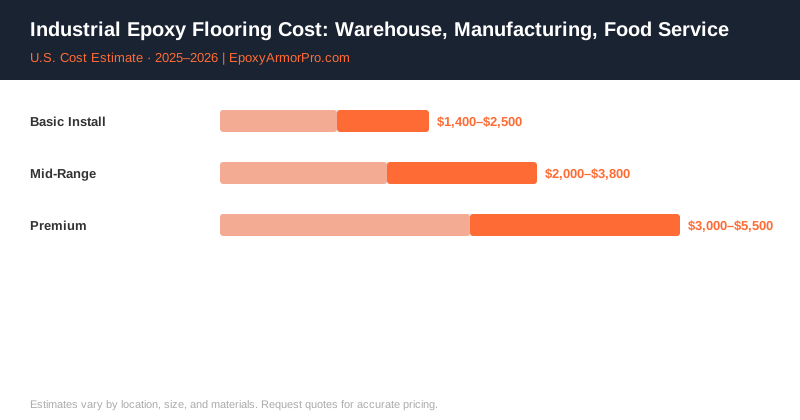
$2.00–$5.00 per square foot
A typical system: diamond-grind the slab, apply a penetrating primer, 2–3 coats of 100% solids epoxy at 20–40 total mils, and a polyurethane or polyaspartic topcoat for chemical resistance. Safety striping (yellow line marking, hazard zones) adds $0.25–$0.75/sq ft.
For a 10,000-square-foot warehouse, expect $20,000–$50,000 total.
Manufacturing Floors (Medium to Heavy Duty)
Manufacturing adds mechanical stress, frequent chemical exposure, and often temperature extremes:
$3.50–$7.00 per square foot
The jump in cost comes from thicker build (40–60 mils), chemical-resistant topcoats formulated for specific solvents or lubricants, anti-static dissipative options for electronics manufacturing, and longer surface prep requirements on floors that may have years of oil contamination embedded in the concrete.
Anti-static (ESD) flooring for electronics or chemical plants adds $1.00–$2.00/sq ft to the base system cost.
Food Service and Commercial Kitchens
This is the most demanding specification in epoxy flooring. USDA-accepted systems and FDA food-contact compliance requirements drive both product cost and application complexity:
$4.00–$8.00 per square foot
Food service floors need:
- Seamless surfaces with coved base (floor-to-wall transition) to prevent bacterial harborage
- Urethane cement or quartz-broadcast systems for thermal shock resistance (steam cleaning, rapid temperature cycling)
- Slip resistance meeting OSHA STD 1-1.13 requirements for wet commercial kitchen environments
- Chemical resistance to harsh degreasers, bleach solutions, and acidic food byproducts
The coved base (running up the wall 4–6 inches with a rounded transition) adds significant labor and is non-negotiable for health code compliance in many states.
Cold Storage and Freezer Floors
Applying epoxy over concrete that cycles between freezing and ambient temperatures is genuinely challenging chemistry:
$5.00–$9.00 per square foot
Standard epoxy systems fail in freeze-thaw cycling because the concrete and coating expand and contract at different rates. Cryogenic-rated polyurethane cement or specially formulated cold-temp epoxies are required. Application itself must occur within specific temperature windows, which may require temporary heating of the space.
| Facility Type | Cost Per Sq Ft | System Thickness | Key Requirement |
|---|---|---|---|
| Light-duty warehouse | $2.00–$4.00 | 15–25 mils | Abrasion resistance |
| Heavy warehouse / dock | $3.50–$5.50 | 25–40 mils | Impact, forklift loads |
| Manufacturing (general) | $4.00–$6.50 | 35–60 mils | Chemical resistance |
| Electronics (ESD) | $5.00–$7.50 | 40–60 mils + ESD | Static dissipation |
| Food service kitchen | $4.50–$8.00 | 50–80 mils | Seamless, FDA, coved base |
| Cold storage / freezer | $5.00–$9.00 | 40–70 mils | Thermal shock, cryo-rated |
What Surface Prep Actually Costs at Scale
Residential prep is often the biggest cost variable. At industrial scale, it’s even more pronounced. A warehouse floor with years of oil contamination may need shot blasting — a process that uses steel shot projected at high velocity to strip and profile the concrete surface.
Shot blasting at 10,000–50,000 square feet runs $0.40–$0.80/sq ft just for the prep step. A heavily contaminated manufacturing floor requiring oil degreasing plus shot blasting plus crack repair can add $1.50–$2.50/sq ft to the project before any coating goes down.
Sequencing and Business Interruption
For operating facilities, the biggest hidden cost is business interruption. A 20,000-square-foot warehouse floor takes 3–5 days to complete with proper cure time between coats. That means either:
- Phased installation — coating 25–50% of the floor at a time, moving operations to the cured section
- Weekend/overnight scheduling — premium labor rates for off-hours work (typically 25–40% surcharge)
- Shutdown windows — planned maintenance periods where full shutdown is coordinated
For food service operations, this is especially complex because health codes may require a complete deep clean before reopening after flooring work. Factor in 1–2 additional days.
Getting Industrial Bids Right
Commercial epoxy bidding is different from residential. Key things to require in any commercial quote:
- Written specification — manufacturer, product series, DFT (dry film thickness) in mils
- ASTM compliance — which standards does the system meet? (ASTM C413, C811, F1869 are common)
- Warranty terms — most quality industrial systems carry 3–10 year manufacturer warranties, but only when installed by certified applicators
- Installer certification — many commercial epoxy manufacturers require contractor certification. Ask whether the bidder is a certified applicator for the products they’re quoting
For smaller commercial spaces crossing into residential territory — think a home workshop or small commercial unit — the residential cost factors guide covers the overlap zone.
Contractor Referral Disclaimer: EpoxyArmorPro is a contractor referral and cost information service, not a licensed flooring contractor. We connect consumers with independent, licensed, and insured contractors. We do not perform any flooring work directly. Cost estimates are averages based on market data and vary by location, project size, materials, and contractor. Always verify contractor licensing and insurance before hiring. Individual quotes may differ from estimates shown.