Hospital-acquired infections cost the US healthcare system an estimated $28 billion annually, according to the CDC — and the floor under patients’ feet is part of the infection control story. Not the biggest part, but a real one.
That’s the practical reason why medical facilities don’t just use whatever epoxy a local garage contractor pours. Healthcare flooring specs are tighter, the products are different, and the installation process is more demanding. Here’s what those differences actually cost, and what you’re getting for the premium.
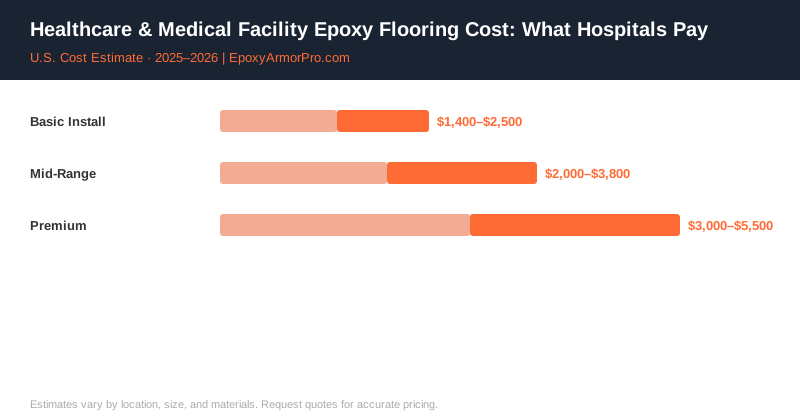
What Healthcare Epoxy Flooring Actually Costs
The gap between residential and medical-grade epoxy is significant and justified.
| Facility Area | Cost per Sq Ft (Installed) | Key Spec Requirement |
|---|---|---|
| Medical office / clinic | $7–$10 | Seamless, antimicrobial, slip-rated |
| Hospital corridor / patient room | $8–$12 | Chemical resistance, cove base, easy-clean |
| Operating room / sterile field | $10–$14 | Maximum chemical resistance, specific COF, ESD control |
| Sterile processing / CSR | $10–$14 | Thermal cycling, steam, aggressive disinfectants |
| Laboratory / research | $9–$13 | Chemical resistance, anti-static options |
| Pharmacy / compounding | $8–$12 | FDA facility guidance, seamless required |
For comparison, a standard residential garage epoxy system runs $3–$8 per square foot. The healthcare premium reflects specialized products, tighter installation standards, and the operational complexity of working inside occupied or semi-occupied buildings.
What’s Actually Different About Medical-Grade Epoxy
Seamless Construction
This is the foundational requirement. Tile, VCT, and other joint-based flooring systems create seams — and seams harbor pathogens. The CDC’s guidelines on healthcare environmental surfaces consistently emphasize non-porous, seamless flooring in patient care areas for this reason. Seamless epoxy eliminates those harbor points entirely.
Antimicrobial Additives
Medical-grade epoxy systems frequently incorporate silver ion-based antimicrobial compounds (AgION, Microban, or equivalent) either in the coating itself or in the topcoat. These compounds disrupt bacterial cell membranes and reduce surface bioburden between cleaning cycles. They don’t replace cleaning protocols — they supplement them.
The antimicrobial additive typically adds $0.50–$1.50 per square foot to the installed cost, depending on the system and the concentration specified.
Slip Resistance to ASTM Standards
The Americans with Disabilities Act (ADA) recommends a minimum coefficient of friction of 0.60 for level walking surfaces in public facilities. Healthcare facilities typically spec higher — 0.65–0.80 wet COF — because wet floors in patient care areas with vulnerable populations have severe consequences.
ASTM D2047 is the standard method for testing slip resistance of polish-coated floor surfaces. ASTM F2508 covers pedestrian walkway testing. Medical facility flooring specs commonly call out one or both as compliance requirements.
Chemical Resistance to Hospital Disinfectants
Residential epoxy handles typical household cleaners. Healthcare epoxy has to handle quaternary ammonium compounds (quats), bleach solutions (0.5%–1.0%), peracetic acid, hydrogen peroxide vapor (for terminal disinfection of ORs), and isopropyl alcohol at clinical concentrations. These are aggressive chemicals, and not all epoxy formulations hold up under repeated exposure without degrading, yellowing, or losing surface integrity.
Integral Cove Base
Just like commercial kitchens, healthcare areas require the floor to seamlessly transition to the wall — no seam at the floor-wall joint. This coved base runs 4–6 inches up the wall in most healthcare specs and is installed in the same material as the floor for continuous cleanability. The cove base adds $8–$15 per linear foot and is included in the overall system cost for most medical flooring contractors.
What the Installation Process Looks Like
Healthcare flooring installations have constraints that residential and most commercial projects don’t:
Working in occupied buildings: Most healthcare facilities can’t shut down a corridor or patient wing for days. Medical flooring contractors typically work off-hours (nights, weekends) in sections, maintaining access and infection control barriers throughout. Off-hours work adds to the labor cost.
Dust control: Diamond grinding generates silica dust. In a healthcare setting, dust containment is not optional — contractors use negative-pressure enclosures, HEPA-filtered equipment, and follow ICRA (Infection Control Risk Assessment) protocols similar to those used in construction projects near patient areas.
Faster-cure systems: To return areas to service quickly, healthcare projects often specify polyaspartic or fast-cure epoxy systems rather than standard slow-cure epoxy. Fast-cure products can return to foot traffic in 4–6 hours and vehicle traffic in 12–24 hours, versus 24–72 hours for standard epoxy. This capability commands a price premium but is often required by the facility.
Third-party documentation: Hospitals, especially those seeking Joint Commission accreditation or CMS certification, may require contractor documentation of products used, installation records, and compliance certifications. More paperwork, more time, more cost.
Leading Products and Manufacturers
Unlike the residential market where product differentiation is mostly aesthetic, the medical flooring market has established manufacturers with specifically engineered systems:
- Stonhard (Tremco/Stonhard): Stonclad UT and Stonkote systems widely specified in hospitals and pharma
- Sika: Sikafloor Purcem and SL resin systems with antimicrobial options
- Flowcrete: Deckshield and Flowfast for healthcare, specified by NHS in the UK and increasingly in US facilities
- BASF MasterTop: Industrial seamless systems used in pharma and healthcare
These aren’t products you’ll find at Home Depot. They’re specified and installed by commercial flooring contractors with manufacturer certification training.
When to Consider ESD Flooring Instead
Some healthcare areas — operating rooms, cardiac cath labs, cardiac ICUs, and areas with electronic life-support equipment — require not just seamless flooring but electrostatic control (ESD) flooring. Electrostatic discharge can damage sensitive electronics and, in environments with flammable anesthetic gases (rare now but still a compliance consideration in some facilities), poses a theoretical safety risk.
ESD flooring in healthcare typically costs $10–$18 per square foot installed and requires compliance with NFPA 99 (Health Care Facilities Code) and relevant ANSI/ESD standards. That’s a separate specialized system — covered in more detail in the static control ESD flooring guide.
Getting the Right Contractor
Healthcare flooring is a specialized segment. When vetting contractors:
- Ask for healthcare-specific references — hospitals, medical offices, clinical labs
- Confirm they’ve completed manufacturer certification for the product they’re proposing
- Ask about their ICRA compliance protocol for in-facility work
- Request the manufacturer’s chemical resistance data sheet for your primary disinfectant
- Confirm off-hours availability if your facility can’t close patient care areas
The floor in a medical facility isn’t just an aesthetic choice. It’s part of your infection control infrastructure. Spec it accordingly.
Contractor Referral Disclaimer: EpoxyArmorPro is a contractor referral and cost information service, not a licensed flooring contractor. We connect consumers with independent, licensed, and insured contractors. We do not perform any flooring work directly. Cost estimates are averages based on market data and vary by location, project size, materials, and contractor. Always verify contractor licensing and insurance before hiring. Individual quotes may differ from estimates shown.