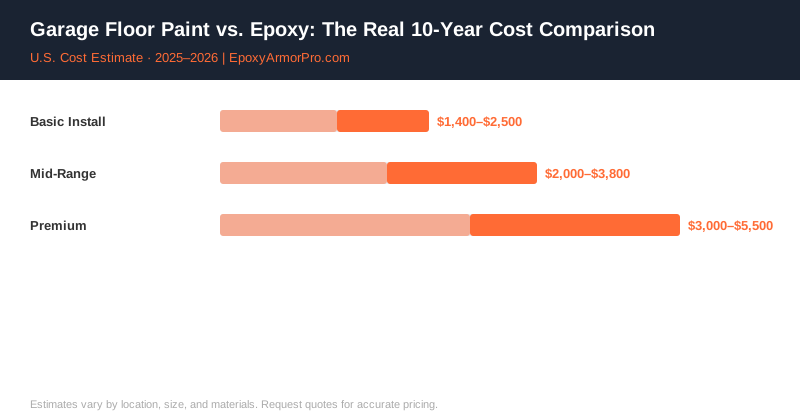
Most people who paint their garage floor regret it within two years. That’s not an opinion — it’s nearly the universal complaint on every contractor forum and homeowner review site: the paint peels, usually in patches near the door where hot tires sit, and the floor ends up looking worse than bare concrete.
So why do people still buy garage floor paint? Because it’s $40 at Home Depot and takes an afternoon. The appeal is obvious. The problem is that cheap entry cost can lead to a worse total outcome than spending more upfront. Let’s look at what each option actually costs over time.
The Three Products You’re Actually Choosing Between
The market has three distinct tiers, and they’re often lumped together under “garage floor coating”:
1-part latex floor paint — This is what most big-box home stores sell as “garage floor paint.” Despite often having “epoxy” somewhere on the packaging, most are 1-part latex or alkyd formulas. They’re easy to apply and dry quickly, but they don’t chemically cure — they just dry. The result is a film coating, not a bonded system.
2-part water-based epoxy — These require mixing a resin and hardener immediately before application. The chemical cross-linking process creates a much harder, more adhesion-resistant film. This is what most epoxy flooring DIY kits sold at home improvement stores actually are. Better than paint, and a legitimate option for light-duty garages.
100% solids epoxy — The professional standard. No water, no solvents — every drop you apply stays in the cured film. Results in 15–20 mils of thickness versus 3–5 mils for water-based systems. This is what contractor-applied systems typically use.
Cost Comparison: Side by Side
| Product | Material Cost (DIY) | Installed Cost (Contractor) | Expected Lifespan |
|---|---|---|---|
| 1-part latex floor paint | $0.25–$0.50 per sq ft | N/A (DIY only) | 1–3 years |
| 2-part water-based epoxy (DIY kit) | $1.50–$3 per sq ft | $3–$5 per sq ft | 3–5 years |
| 100% solids epoxy (contractor) | $3–$5 per sq ft (materials) | $5–$7 per sq ft | 7–15 years |
| Polyaspartic topcoat upgrade | +$1–$2 per sq ft | Adds 3–5 years lifespan | — |
For a standard 2-car garage (480 sq ft), that’s roughly:
- Floor paint (DIY): $120–$240
- 2-part epoxy kit (DIY): $720–$1,440
- 100% solids epoxy (contractor): $2,400–$3,360
The floor paint looks dramatically cheaper. It isn’t, once you factor in that you’ll likely redo it every 2–3 years — and each redo requires stripping the peeling paint first, which adds time and prep cost. A 2018 study by the National Association of Home Builders found that garage floor coatings are among the most repurchased home improvement products, with 1-part paint buyers replacing their coating 3–4x more often than buyers of 2-part epoxy systems over a 10-year period.
The Hot Tire Pickup Problem
This is worth its own section because it surprises so many homeowners. Your car’s tires reach 140–160°F during normal highway driving. When you pull into the garage and park, that heat transfers to the floor coating at the tire contact patch.
1-part latex paints soften at those temperatures. The tire bonds to the softened paint. When you back out, the paint lifts with the tire. It’s not a product defect you can return — it’s a fundamental material limitation.
2-part epoxy and 100% solids systems have significantly higher heat distortion temperatures and resist this failure mode. The American Concrete Institute notes that latex floor coatings on concrete provide minimal chemical bond and are not recommended for vehicular traffic areas — and hot tire pickup is exactly why.
DIY Difficulty: What Changes at Each Tier
| Factor | Floor Paint | 2-Part Water-Based Epoxy | 100% Solids Epoxy |
|---|---|---|---|
| Mixing required | No | Yes (resin + hardener) | Yes — precise ratio critical |
| Pot life (working time) | Unlimited | 2–4 hours | 20–45 minutes |
| Surface prep required | Light acid etch | Medium acid etch or grind | Diamond grind recommended |
| Moisture testing needed | No | Recommended | Yes |
| Number of coats | 2 | 2 | 2–3 |
| DIY difficulty | Easy | Intermediate | Hard |
The short pot life of 100% solids epoxy is the biggest DIY challenge — 20–45 minutes to mix, apply, and back-roll the entire wet section before it starts to kick. Contractors handle this by staging sections, working in teams, and having the right roller frames ready. Most homeowners find the time pressure stressful and end up with lap marks.
Which Option to Choose
Choose 1-part floor paint if: You rent, you have a temporary need, or the garage floor is already in rough shape and you’re not ready to address it properly. Accept that it’ll peel and plan accordingly.
Choose 2-part water-based epoxy (DIY) if: You have a light-duty garage — one or two cars, no heavy work, no floor jack use — and you want a meaningful upgrade on a moderate budget. It’ll last 3–5 years and hold up well under normal residential conditions.
Choose contractor-applied 100% solids epoxy if: You use your garage as a workspace, park heavy vehicles, want a lasting result, or plan to sell the home in the next few years. The ROI on a properly installed epoxy floor versus the repainting cycle typically favors the professional install by year four or five.
Contractor Referral Disclaimer: EpoxyArmorPro is a contractor referral and cost information service, not a licensed flooring contractor. We connect consumers with independent, licensed, and insured contractors. We do not perform any flooring work directly. Cost estimates are averages based on market data and vary by location, project size, materials, and contractor. Always verify contractor licensing and insurance before hiring. Individual quotes may differ from estimates shown.