Water expands by 9% when it freezes. That doesn’t sound like much. But inside the microscopic pores and capillaries of a concrete slab, that 9% expansion generates pressures up to 2,000 psi — more than enough to fracture concrete from the inside out.
This is freeze-thaw damage, and it’s the single biggest cause of concrete deterioration in northern states. If you’re in a region that sees real winters, your uncoated garage floor is experiencing this every year.
The Physics of Freeze-Thaw Damage
Concrete isn’t a solid block — it’s a porous matrix riddled with capillary pores at scales from nanometers to millimeters. Freshly cured concrete has a water-cement ratio that determines its porosity: a higher ratio means more water content and more residual porosity after curing. Most residential garage slabs aren’t mixed to the tightest specs, which means they’re typically more porous than commercial flooring.
When water enters these pores and freezes, it expands outward. The surrounding concrete resists that expansion — and something has to give. With a single cycle, the damage is microscopic. After 10, 50, 100 cycles, the accumulated damage produces the classic symptoms:
- Surface scaling: The top 1/16" to 1/4" of concrete flakes off in thin sheets
- Spalling: Larger chunks break away from the surface, leaving pockmarks and craters
- Cracking: Internal pressure opens cracks that then trap more water for more damage
- Pop-outs: Aggregate particles near the surface fracture and pop out, leaving conical voids
NOAA data shows that cities like Minneapolis see approximately 156 freeze-thaw cycles per year — days where temperatures cross the 32°F threshold at least once. Chicago averages around 100. Cleveland and Detroit, 80–100. Each one of those cycles is working on your unprotected slab.
| City | Avg. Annual Freeze-Thaw Cycles | Uncoated Concrete Risk |
|---|---|---|
| Minneapolis, MN | ~156 | Very high |
| Chicago, IL | ~100 | High |
| Cleveland, OH | ~90 | High |
| Detroit, MI | ~85 | High |
| Buffalo, NY | ~95 | High |
| Denver, CO | ~100 | High |
| Pittsburgh, PA | ~80 | Moderate-high |
| Washington, DC | ~60 | Moderate |
How Epoxy Stops the Cycle
The physics is simple: if water can’t get into the concrete, it can’t freeze in the pores, and it can’t cause damage. A properly installed epoxy coating system blocks water infiltration at the surface, eliminating the source of freeze-thaw damage.
The coating acts as the waterproof barrier. Rain, snowmelt, and brine that land on a coated floor sit on top of the epoxy and can be rinsed or mopped away. None of it reaches the concrete below.
For this protection to be effective:
- The coating needs to be a low-permeability system (100% solids epoxy is far better than water-based)
- Film thickness matters — thicker coatings have lower vapor permeability
- Coverage needs to be complete — any pinholes, thin spots, or cracks in the coating are water entry points
- Edges and floor-wall joints must be sealed
A quality installed epoxy system significantly extends the service life of concrete. The Concrete Network estimates that properly coated garage floors last 2–3 times longer than uncoated floors in freeze-thaw climates before requiring surface repair.
The Spalling Spiral
Here’s why waiting too long is costly: freeze-thaw damage is self-reinforcing. Each crack and spall pit creates more surface area for water collection, and more surface area means more water infiltrating on the next rain or snowmelt event.
A smooth, dense concrete surface sheds water relatively well even without a coating. Once scaling starts and the surface becomes rough and pitted, water retention increases dramatically. Small cracks act as channels and reservoirs. The rate of damage accelerates year over year.
A slab that shows minor scaling at 10 years can look dramatically worse at 15. And once spalling progresses deeply enough, you’re looking at surface grinding and patching before any coating can be successfully applied.
Assessing Your Slab Before Coating
Before an epoxy install, a professional contractor should evaluate the condition of your concrete for freeze-thaw damage. The standard assessment:
Soundness test: Tapping the surface with a steel rod or hammer — hollow sounds indicate delaminated zones where the surface has separated from the underlying concrete. These areas must be removed before coating.
Surface pull-off test: Using a dolly-type adhesion tester per ASTM D4541, the contractor can measure how much force is required to pull the surface layer away. Sound concrete should test above 200 psi. Heavily freeze-thaw damaged concrete often tests well below this.
Visual assessment: Scaling, spalling, pop-outs, and cracks are visible. The extent tells a contractor how much grinding and patching is needed.
- Surface that’s rough, flaky, or chalky (scaling)
- Pockmarks or craters where aggregate has popped out
- Visible cracks wider than 1/16"
- White, powdery deposits (efflorescence — a sign of water moving through the slab)
- Any area that sounds hollow when tapped firmly
What Prep and Coating Costs in Cold-Climate States
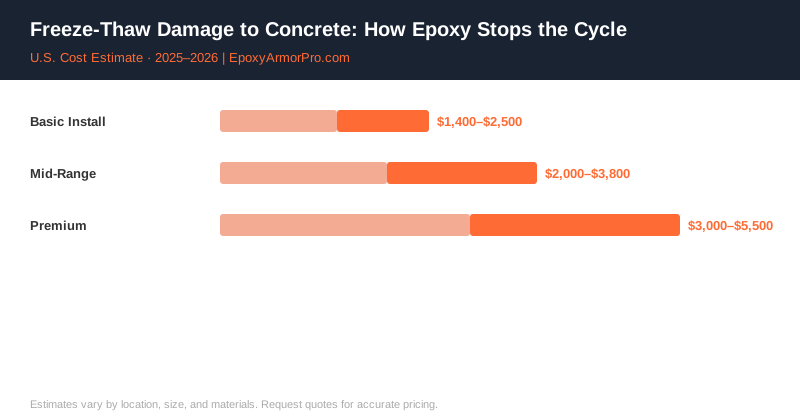
The more freeze-thaw damage present, the higher the prep cost before coating. Here’s a realistic cost range for northern state garage projects:
| Service | Cost Range |
|---|---|
| Standard 2-car garage epoxy + topcoat | $1,200–$2,400 |
| Diamond grinding (for scaled surface) | +$300–$600 |
| Spall patching (per pit) | $15–$40 per repair |
| Crack injection/filling | $5–$15 per linear foot |
| Full surface shot blast + regrind | +$400–$900 for severe damage |
For context on what drives total costs, our garage epoxy flooring guide has a full breakdown.
Repairing Freeze-Thaw Damage: Before You Coat
Our guide to fixing garage floor cracks covers the repair process in detail, but the short version for freeze-thaw damage:
- Remove all delaminated and scaled concrete with a floor grinder until you reach sound substrate
- Fill spall pits with a cementitious patching compound rated for freeze-thaw resistance (look for ASTM C928 compliant products)
- Fill cracks with a flexible polyurea or epoxy injection material
- Profile the surface for coating adhesion (typically 30–60 grit CSP — Concrete Surface Profile)
- Apply moisture-tolerant primer, then full epoxy system
Skipping any step tends to result in a failed coating within 2–3 years.
The Long View
An unprotected concrete slab in Minneapolis, Cleveland, or Chicago has a service life before needing major repair of roughly 20–30 years under ideal conditions — less if it’s exposed to salt. An epoxy-protected slab in the same climate can last 40–50 years with routine maintenance. The coating doesn’t just make the floor look better. It genuinely extends its structural life.
Contractor Referral Disclaimer: EpoxyArmorPro is a contractor referral and cost information service, not a licensed flooring contractor. We connect consumers with independent, licensed, and insured contractors. We do not perform any flooring work directly. Cost estimates are averages based on market data and vary by location, project size, materials, and contractor. Always verify contractor licensing and insurance before hiring. Individual quotes may differ from estimates shown.