Walk through any home improvement store and you’ll find concrete paint and epoxy coating sitting within ten feet of each other, often at similar price points. It’s an easy mistake to assume they’re basically the same product at different price tiers. They’re not. The performance difference is dramatic, and the homeowners who discover this usually do so the hard way — when their painted floor starts peeling eighteen months after application.
What Concrete Paint Actually Is
Concrete paint is a latex or acrylic paint reformulated with a slightly harder resin to adhere to concrete surfaces. It’s essentially the same chemistry as interior wall paint, optimized marginally for a harder substrate.
It builds 2–4 mils of dry film. It doesn’t chemically bond to concrete — it mechanically adheres, meaning it sits on the surface rather than penetrating it. And because it has zero chemical or solvent resistance, anything that dissolves paint — gasoline, oil, brake fluid, driveway de-icing salt — will degrade it rapidly.
What Epoxy Coating Actually Is
Epoxy is a two-part reactive system. When you mix the resin and hardener, a chemical reaction produces a cross-linked polymer film that’s fundamentally different from dried paint. A 100% solids professional epoxy system builds 10–30 mils of dry film — six to ten times the thickness of concrete paint — and achieves a Shore D hardness rating around 80, comparable to some plastics.
The key difference: epoxy doesn’t just sit on concrete. After diamond grinding the surface, the epoxy penetrates the concrete’s pore structure and mechanically locks in. That’s why it doesn’t peel under normal conditions. It’s not a coating that can be scraped off — it becomes part of the surface.
Lifespan: The Honest Numbers
The Concrete Network estimates professionally installed epoxy lasts 10–20 years under residential garage conditions with normal use. Many properly installed systems exceed that.
Concrete paint on a garage floor? Most homeowners see peeling within 1–3 years, sometimes faster. The American Concrete Institute has documented that topical paint coatings on garage-grade slabs fail at dramatically higher rates than epoxy systems due to moisture vapor transmission, chemical exposure, and thermal cycling.
| System | Dry Film Thickness | Typical Lifespan | Cost (per sq ft) | 400 sq ft Garage |
|---|---|---|---|---|
| Latex concrete paint (DIY) | 2–4 mils | 1–3 years | $0.15–$0.40 | $60–$160 materials |
| Acrylic concrete stain | 1–3 mils | 2–4 years | $0.20–$0.50 | $80–$200 materials |
| Water-based “epoxy paint” (DIY) | 3–6 mils | 2–5 years | $0.40–$1.00 | $160–$400 materials |
| Professional water-based epoxy | 5–10 mils | 5–8 years | $2–$4 installed | $800–$1,600 |
| Professional 100% solids epoxy | 10–30 mils | 10–20 years | $4–$8 installed | $1,600–$3,200 |
The Real Cost Comparison
Paint looks cheap upfront. A gallon of concrete paint covering 400 sq ft might cost $40. For a two-car garage, you’re looking at $80–$150 in materials. That’s a compelling number.
But here’s the math most people don’t run: paint that fails in two years has to be removed before you can apply anything new. Paint removal from concrete — grinding, chemical stripping, or both — adds $1–$2 per square foot to whatever comes next. So your “cheap” paint job has now cost you $150 in materials, plus two years of looking at a peeling floor, plus $400–$800 in surface prep before you can coat it properly.
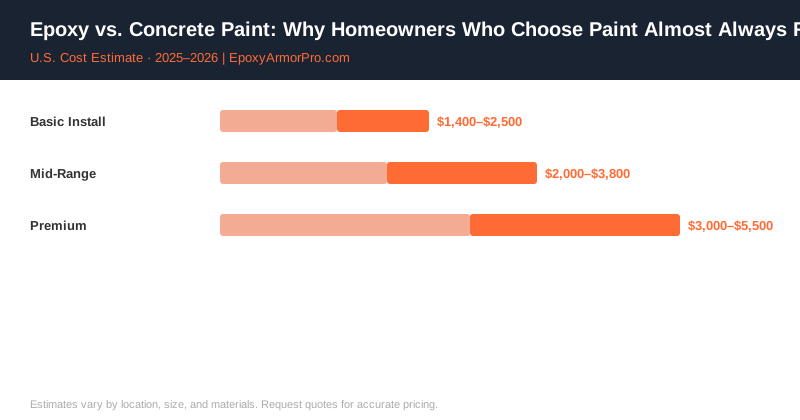
Done right the first time with a 100% solids epoxy: $1,600–$3,200 for a two-car garage. Spread over 15 years, that’s roughly $110–$215 per year. The paint approach, requiring reapplication every two to three years plus eventual remediation, often costs more over a decade.
Why Paint Fails on Garage Floors Specifically
Garages are hostile environments for paint. Three mechanisms cause most failures:
Moisture vapor transmission: Concrete slabs continuously transmit moisture vapor from below. Paint films aren’t thick enough or chemically bonded enough to withstand this constant outward pressure. The vapor gets beneath the paint film and pushes it off the slab — that’s where those classic paint bubbles and peel patches come from.
Hot tire pickup: When you pull a hot tire off summer pavement and park it on a painted concrete floor, the tire’s contact patch heats the paint surface to 150–180°F. The paint softens, the tire pulls it off the floor when you back out, and you get those crescent-shaped peel marks that are a dead giveaway for a painted garage floor.
Chemical exposure: Motor oil, gasoline, brake fluid, antifreeze — all of these attack acrylic paint chemistry. An oil drip from a parked car that sits for a week will stain through paint. On a 100% solids epoxy floor, you wipe it up.
When Paint Makes Any Sense At All
To be fair: there are situations where concrete paint is a reasonable choice.
- Temporary use or rental properties: If you’re coating a basement or garage floor in a rental property you’re planning to sell, and you just need it to look better for a showing — paint is cheap and fast.
- Indoor spaces with no vehicle traffic, chemicals, or moisture exposure: A basement storage room that’s bone dry and never sees spills can handle paint significantly longer than a garage.
- Test patches: If you want to understand the color before committing to epoxy, a small patch of paint can be illustrative — just know it’ll peel.
For any floor you’re going to look at for the next decade, paint is a false economy.
The Bottom Line
The $80 paint job and the $2,000 epoxy job don’t solve the same problem. Paint makes your floor look different temporarily. Epoxy makes your floor perform differently, permanently.
If you’re renovating a garage floor you want to be proud of — one that handles vehicles, tools, and spills for the next 15 years — skip the paint conversation entirely. Get quotes on a real 100% solids epoxy system. For more on what good prep looks like before any coating, see the crack repair guide first.
Contractor Referral Disclaimer: EpoxyArmorPro is a contractor referral and cost information service, not a licensed flooring contractor. We connect consumers with independent, licensed, and insured contractors. We do not perform any flooring work directly. Cost estimates are averages based on market data and vary by location, project size, materials, and contractor. Always verify contractor licensing and insurance before hiring. Individual quotes may differ from estimates shown.