The contractor hands you a brochure that says “10-year warranty” in bold. You feel good about the investment. Then two years in, your floor starts peeling, and you call to make a claim — and suddenly the warranty has more exceptions than coverage.
This is one of the most common complaints the BBB receives about flooring contractors. In 2023, flooring-related warranty disputes ranked among the top five home improvement complaint categories nationwide, with “warranty not honored as stated” cited in the majority of cases.
Understanding what a real epoxy warranty covers — and what kills it — is something you need to do before you sign the contract, not after you’re standing on a failing floor.
Two Kinds of Warranties (and Why the Difference Matters)
Every epoxy flooring job comes with at least one of these, and ideally both:
Installer warranty: The contractor personally guarantees their labor and workmanship. If the coating fails because of poor prep, incorrect mixing, or application errors, they come back and fix it at no cost. This is the warranty that actually protects you from the most common failure modes — because most epoxy failures are installation failures, not product failures.
Manufacturer warranty: The coating product itself is guaranteed against defects. If the epoxy formula was faulty or the batch was bad, the manufacturer covers replacement material costs. Manufacturer warranties typically don’t cover labor costs for removal and reinstallation.
The best scenario: a contractor who uses a named commercial product and provides their own workmanship warranty on top of the manufacturer’s product warranty. The worst scenario: a verbal “we stand behind our work” from a contractor who uses an unnamed product and has no documentation you can reference.
What Realistic Warranty Lengths Look Like
| System Type | Realistic Installer Warranty | Manufacturer Warranty |
|---|---|---|
| Standard 2-coat epoxy (DIY materials) | 0–1 year | 1 year (material only) |
| Professional 100% solids epoxy system | 2–5 years | 2–3 years (material only) |
| Epoxy + polyaspartic topcoat system | 3–7 years | 3–5 years |
| Full broadcast flake with UV-stable topcoat | 5–10 years | 5 years |
| Commercial/industrial heavy-duty system | 5–15 years | 5–10 years |
Be skeptical of any residential installer offering a 10-year warranty without a premium system to back it up. A warranty is only as good as the business behind it — a one-person operation offering 10 years of coverage has to survive as a business for 10 years to honor it.
What a Real Warranty Covers
A legitimate written warranty should specifically address:
Delamination and peeling: The coating separating from the concrete substrate is the most common failure mode. It should be covered under the workmanship warranty unless you can prove the homeowner caused it.
Bubbling and blistering: Usually caused by moisture vapor transmission or improper surface prep — installation failures, not product failures. Should be covered under workmanship.
Premature wear-through: If the coating wears through under normal use within the warranty period, that’s a materials or application failure.
Hot tire pickup: Tires can pull the coating off in hot weather, especially with cheaper systems. Premium systems with polyaspartic topcoats are significantly more resistant. Whether this is covered depends on the system specified — it should be clearly stated.
What Almost Always Voids an Epoxy Warranty
This is where most warranty claims die. Read your contract before signing and push back on any clause that makes the warranty practically uncollectable.
Improper cleaning products: Many warranties are voided by using anything other than a pH-neutral cleaner. That means no bleach, no ammonia, no standard floor cleaners. If the contract says this, ask what specifically you can use — and get that in writing too.
Dragging heavy objects: Some warranties exclude damage from dragging equipment, floor jacks, or heavy items. This can cover a lot of normal garage use.
Chemical spills: Motor oil, transmission fluid, battery acid. A warranty that excludes all chemical exposure is almost useless in a garage environment. Quality coatings are designed to resist these — that’s the whole point.
Temperatures outside a narrow range: Some warranties exclude damage from extreme heat or cold, which is relevant for unheated garages in cold climates.
Lack of maintenance documentation: A few warranty contracts require you to log cleanings or maintenance visits to keep the warranty active. If you can’t prove you maintained the floor, they won’t cover it.
Using the floor “beyond intended use”: Vague language that lets the contractor decide after the fact whether your use was appropriate.
Red Flags in Warranty Language
Watch for these phrases in warranty documents. Each one is a warning sign:
- “Normal wear and tear is excluded” — fine in principle, but how it’s applied matters. Peeling after 18 months is not normal wear and tear. Make sure the contract defines what “normal” means.
- “Warranty is non-transferable” — this matters if you sell your house. Some warranties end the moment you sell, even if there are years left. A transferable warranty can add real value to a home sale.
- “Subject to inspection before repair” — reasonable, but make sure there’s a response timeframe. “We’ll come inspect it when we can get there” can drag on indefinitely.
- “Warranty void if substrate was previously treated” — this is legitimately important (prior coatings affect adhesion), but the contractor should have identified and disclosed this before installation, not hidden it in the warranty terms.
- “Acts of God” or “unforeseen circumstances” clauses so broad they can apply to anything — flooding, temperature swings, sun exposure.
How to Protect Yourself Before Installation
Get the warranty in writing before work starts. Not after. If a contractor won’t put warranty terms in writing in the contract, they’re not planning to honor them.
Ask what specifically voids the warranty. Walk through scenarios: “If I use this cleaning product, does that void it? What about dragging a motorcycle stand across it?”
Ask about the claims process. Who do you contact? What’s the response time? Is there an inspection process? Is there a dollar cap on warranty repairs?
Ask who performs warranty work. If the contractor subcontracts installation, who does warranty repairs — the contractor or the sub? This matters if the business structure changes.
Photograph everything on completion day. Date-stamped photos of the finished floor give you a baseline record if you ever need to prove the failure wasn’t pre-existing.
The Relationship Between Warranty Length and System Quality
There’s a reason certain systems carry longer warranties: they’re built to last longer. A full epoxy system with a UV-stable polyaspartic topcoat genuinely holds up better than a basic two-coat epoxy with no topcoat. When a contractor offers a longer warranty, it should be tied to a more expensive, higher-specification system.
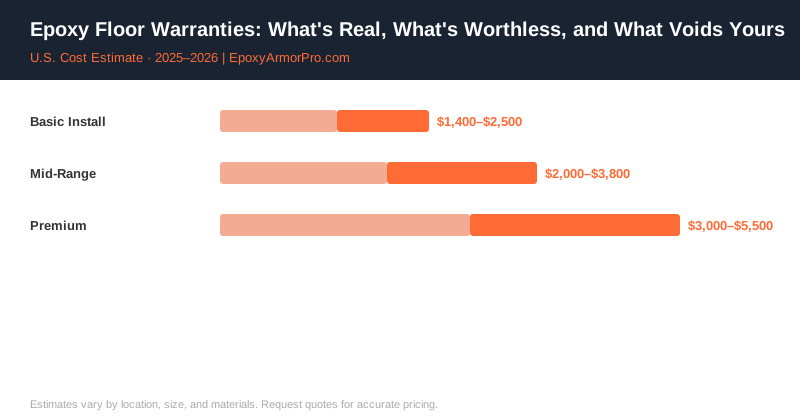
If you’re being offered a long warranty but the price is in the low range for installed professional epoxy ($2–$3 per square foot), something doesn’t add up. Either the warranty language is written to be difficult to claim, or the system doesn’t match the warranty promise.
For a full comparison of system types and durability, see our Epoxy vs. Polyaspartic guide and our overview of what factors drive epoxy flooring costs.
Contractor Referral Disclaimer: EpoxyArmorPro is a contractor referral and cost information service, not a licensed flooring contractor. We connect consumers with independent, licensed, and insured contractors. We do not perform any flooring work directly. Cost estimates are averages based on market data and vary by location, project size, materials, and contractor. Always verify contractor licensing and insurance before hiring. Individual quotes may differ from estimates shown.