Every epoxy product has two separate temperature conversations: what temperature it needs to go down correctly, and what temperature it can handle once it’s cured. Most homeowners only think about one — usually neither — and then wonder why the floor failed or why their hot car tires are sticking.
Let’s separate these clearly. They’re different problems with different solutions.
Part 1: Application Temperature Limits
The Cold Limit: 50°F Minimum
Standard two-part epoxy coatings require a minimum substrate (concrete) temperature of 50°F at application, and the space must maintain that temperature through the initial cure period. Most manufacturers state this in their technical data sheets, and it’s non-negotiable.
Below 50°F, the chemical reaction between epoxy resin and hardener slows dramatically. You end up with:
- Incomplete cross-linking — the polymer chains don’t fully form
- Reduced adhesion to the concrete surface
- A soft, tacky cured surface that looks okay but has little mechanical strength
- Higher susceptibility to amine blush (a waxy surface layer from moisture reacting with the hardener)
In practice, 60°F is where most contractors prefer to work. At 60°F, the reaction runs reliably and cure times are predictable. At 50°F, you’re at the edge — cure times extend significantly, and any temperature drop during the cure window could stall the reaction.
Polyaspartic coatings have a lower cold limit — typically down to 25°F for some formulations — which is why they’re the standard recommendation for fall, winter, and early spring installs. See our winter installation guide for the full cold-weather protocol.
The Heat Limit: 85–90°F Maximum
Here’s the problem that catches Sun Belt homeowners and summer installers: epoxy also has a maximum application temperature.
When a concrete substrate exceeds 85–90°F, the epoxy’s pot life (working time after mixing) drops from a manageable 20–30 minutes to under 10 minutes. The coating sets too quickly to be spread evenly. Results include:
- Lap marks where the contractor’s roller overlapped already-gelling material
- Bubbles from off-gassing — hot concrete releases air and vapor into the wet coating
- Thin spots and coverage gaps
- Reduced adhesion per ASTM D7234 pull-off testing at elevated substrate temperatures
In Phoenix or Las Vegas in July, an unshaded concrete floor can hit 130–140°F by 10 a.m. Even a shaded garage floor can hit 90°F by afternoon in a desert summer. This is why serious contractors in hot climates start at dawn in summer.
The practical rule: measure your concrete temperature with an infrared thermometer before your contractor starts work. If it reads above 85°F, either wait for the substrate to cool (early morning, evening) or delay the project.
| Application Condition | Temperature | Result |
|---|---|---|
| Too cold — standard epoxy | Below 50°F | Incomplete cure, adhesion failure |
| Cold but workable | 50–60°F | Extended cure, higher failure risk |
| Ideal | 60–85°F | Normal cure, full strength |
| Too hot | Above 85–90°F | Shortened pot life, bubbles, thin spots |
| Polyaspartic cold limit | As low as 25°F (product-dependent) | Full cure, faster than epoxy |
Part 2: Cured Epoxy Heat Resistance
Once epoxy is fully cured — typically 7 days to full chemical cure — the temperature questions shift entirely. Now you’re asking: what can this floor handle in daily use?
Standard Epoxy: 140–150°F
Standard two-part epoxy has a heat deflection temperature (HDT) of approximately 140–150°F under load. This is measured by ASTM E1356 and similar thermal analysis methods.
In practical terms: a hot car tire fresh off a summer highway can reach surface temperatures of 120–150°F in direct contact with the road. Pull into a cool garage, and the tire’s contact patch is still very hot. Standard epoxy, especially water-based formulations, can soften enough at these temperatures to bond with the tire rubber — and when you pull out, it takes chunks of coating with it.
This is “hot tire pickup,” the most common complaint about epoxy floors in warm climates. It’s not a defect — it’s the product operating within its thermal limits. The solution is a polyaspartic or polyurethane topcoat with a higher HDT.
Polyaspartic Topcoat: 180–200°F
Aliphatic polyaspartic coatings have significantly higher heat deflection temperatures — typically in the 180–200°F range. This puts them well above the temperature of even very hot tires, eliminating the pickup problem in most real-world conditions.
This is another reason the professional standard for garage floors is epoxy base coat + polyaspartic topcoat, not epoxy-only. The topcoat handles both UV protection and heat resistance simultaneously.
When Heat Resistance Really Matters
- Hot tire pickup: The most common scenario. Solved by polyaspartic topcoat.
- Engine work: If you do your own automotive work, hot engine parts or exhaust components set on the floor can exceed standard epoxy’s HDT. A welding shop or serious home mechanic shop should spec a higher-performance topcoat.
- Outdoor patios and sunrooms: Direct sun on a dark-colored floor in the South or Southwest can push surface temps well above 100°F. Both UV stability and heat resistance matter here.
- Commercial and industrial: Heat sources, hot equipment, steam cleaning — commercial floors typically spec coatings with HDTs in the 200–300°F range using specialized epoxy novolac or vinyl ester systems.
- Standard garage with normal car traffic: 100% solids epoxy + polyaspartic topcoat handles all real-world conditions
- Sun Belt garage (AZ, TX, FL, CA): Polyaspartic topcoat is essential — hot tire pickup risk is high without it
- Automotive shop or frequent hot engine exposure: Ask your contractor about a novolac epoxy system (HDT 250–300°F+)
- Outdoor patio in direct sun: Aliphatic polyaspartic topcoat rated for UV and high surface temps
- Cold-climate winter install: Polyaspartic applied at low temperature if needed, then use same system as above
What Happens When Epoxy Gets Too Cold After Installation
There’s a third temperature scenario that gets less attention: what happens to a cured epoxy floor when it gets very cold?
Fully cured epoxy becomes more brittle at low temperatures — the polymer chains stiffen. In extreme cold (sub-zero garage temperatures), an epoxy floor can develop fine craze cracking if there’s any significant impact. The coating doesn’t fall apart, but impacts that would leave no mark at room temperature may leave a crack in very cold epoxy.
More practically: if temperature drops sharply during the initial cure window (the first 24–72 hours after application), the reaction can stall and the coating may never reach full strength. This is the most common cold-weather failure mode — the floor looked fine, was applied at 55°F, then overnight temps dropped to 35°F before the coating had fully cross-linked.
This is why maintaining heat throughout the cure period isn’t just a suggestion — it’s a requirement.
Cost Implications of Choosing the Right Products
The temperature limits of epoxy systems aren’t a reason to avoid epoxy — they’re a reason to spec the right system for your conditions. In most cases, the upgrade that addresses temperature limitations (polyaspartic topcoat) also addresses UV resistance, adding value far beyond the temperature problem alone.
| System | Heat Resistance | UV Resistance | Cost Range (2-car garage) |
|---|---|---|---|
| Water-based epoxy only | Low (~120°F) | Poor | $400–$900 |
| 100% solids epoxy only | Moderate (~140°F) | Poor | $900–$1,600 |
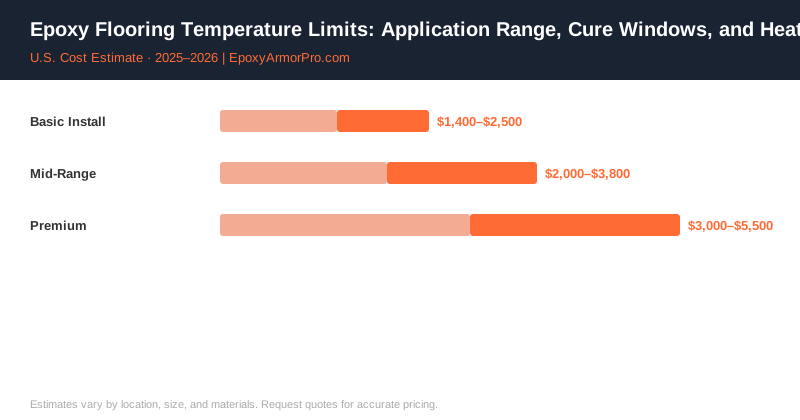
| 100% solids epoxy + polyaspartic topcoat | High (~180–200°F) | Excellent | $1,400–$2,800 |
| Novolac epoxy + topcoat (commercial/shop) | Very high (250°F+) | Good | $2,200–$4,000+ |
For homeowners in normal residential applications, the 100% solids epoxy + polyaspartic topcoat system is the right answer for both temperature and UV protection. It’s the professional standard for a reason.
Contractor Referral Disclaimer: EpoxyArmorPro is a contractor referral and cost information service, not a licensed flooring contractor. We connect consumers with independent, licensed, and insured contractors. We do not perform any flooring work directly. Cost estimates are averages based on market data and vary by location, project size, materials, and contractor. Always verify contractor licensing and insurance before hiring. Individual quotes may differ from estimates shown.