Hardwood floors and dogs don’t mix. Ask anyone who’s watched a large dog scramble across oak planks, leaving claw drag marks from the kitchen to the back door. Laminate fares better but still shows scratches within months of a 70-lb lab with active daily routines. Tile is cold and unforgiving on aging dog joints. What pet owners actually want is a hard surface that doesn’t show every paw-and-nail impact — and that you can clean in 30 seconds when the dog inevitably has an accident.
Epoxy flooring checks most of those boxes well. It’s not perfect — no floor is — but it’s one of the most pet-friendly hard surface options available. Here’s what actually matters.
Scratch Resistance: What Epoxy Can and Can’t Do
Let’s be honest about what epoxy handles and what it doesn’t.
What epoxy handles well: Normal daily dog traffic. A 60-lb dog running across a properly installed 100% solids epoxy floor will not scratch it under normal conditions. Pencil hardness ratings for commercial epoxy topcoats run 3H–5H, comparable to very hard stone. Regular nail contact in a walking or trotting dog isn’t an issue.
What degrades epoxy over time: Repeated high-speed turns by large dogs on the same path. A dog that launches off the same spot 50 times a day — say, in front of a door or at the foot of the stairs — will eventually show micro-abrasion in that zone. Large dogs with dew claws can occasionally catch the surface on a rough landing.
The topcoat choice matters: A polyaspartic topcoat over an epoxy base provides significantly better scratch and abrasion resistance than an epoxy-only system. Shore D hardness for quality polyaspartic topcoats runs 75–80; standard epoxy topcoats run 65–72. For homes with multiple large dogs, the polyaspartic upgrade is worth it. The comparison of epoxy vs. polyaspartic systems has the full technical breakdown.
| Flooring Type | Scratch Resistance (Large Dog) | Slip for Dogs | Odor Sealing | Maintenance |
|---|---|---|---|---|
| Hardwood (oak, unfinished) | Poor | Good | Poor | High |
| Laminate | Fair | Poor | Poor | Moderate |
| Ceramic tile | Excellent | Poor (wet) | Good | Moderate |
| 100% solids epoxy (gloss) | Very Good | Fair | Excellent | Low |
| Epoxy + polyaspartic topcoat | Excellent | Good (with grit) | Excellent | Very Low |
| Luxury vinyl plank | Good | Good | Good | Low |
Slip Resistance for Dogs: The Anti-Slip Specification
Dogs don’t have to say anything. You can tell when a dog is uncomfortable on a slick floor — they spread their legs wider, avoid the surface, move tentatively. A gloss epoxy finish without anti-slip additives can be a real problem for large or elderly dogs.
According to veterinary orthopedic specialists, slipping and falling repeatedly on smooth surfaces is a known contributor to hip and knee joint injuries in dogs — especially breeds already predisposed to hip dysplasia (Labs, Golden Retrievers, German Shepherds). This isn’t trivial.
The fix: aluminum oxide or silica broadcast in the topcoat. It’s the same anti-slip additive used in commercial kitchens. The texture is fine enough that it’s not uncomfortable to human feet, but it provides meaningful traction for a dog’s paw pads. Cost: roughly $0.50–$0.75 additional per square foot.
A matte or satin finish (rather than full gloss) also provides marginally better traction and has the practical benefit of hiding paw prints, water splashes, and nose smears far better than a high-gloss finish.
Odor Sealing: Why This Matters More Than You Think
Bare concrete is a 100% absorbent surface. Dog urine soaks in within seconds and begins bonding to the calcium silicate structure of the concrete. Once there, it’s nearly impossible to fully remove — the odor compounds stay in the slab and off-gas for years, especially on warm days when the slab heats up.
This is why you can clean a bare concrete basement floor 20 times and it still smells like dog in summer. The source isn’t the surface — it’s in the slab.
Epoxy solves this permanently. A properly installed 100% solids epoxy primer penetrates into the concrete surface and creates a chemical barrier that the concrete can no longer absorb through. Accidents that reach the floor sit on the surface, where they can be wiped up with a neutral cleaner, without any penetration into the substrate.
For homes with dogs in a basement or garage area, this alone is often the deciding factor. Homeowners who’ve tried enzyme cleaners, encapsulants, and every pet odor product on the market consistently report that epoxy is the only solution that actually eliminates the underlying problem.
Non-Toxic Coatings: What Certifications to Look For
This is a legitimate concern and worth addressing directly. Epoxy coatings during application release fumes — you and your pets need to be out of the space during application and until fully cured.
Once fully cured, however, quality 100% solids epoxy is chemically inert and non-toxic. The relevant certifications and standards:
GREENGUARD Gold Certification (UL): Products meeting this standard have been tested for over 10,000 VOCs and chemical emissions. A GREENGUARD Gold certified coating meets strict limits on off-gassing after cure. This is the most relevant certification for indoor pet environments.
California Proposition 65 compliance: Products that don’t trigger Prop 65 warnings have been formulated to avoid known carcinogens at regulated thresholds.
Low-VOC formulations: Some manufacturers offer water-based or low-solvent versions with significantly reduced VOC content during application. These are slightly lower performance than 100% solids products but are appropriate for owners who need to return to the space quickly with pets.
Practical timeline for pet return after coating:
- Leave pets out during application and for 24 hours minimum after final coat
- Most quality 100% solids products are pet-safe after 48–72 hours
- For maximum caution, wait 5–7 days for full chemical cure before allowing pets full-time access
Cleaning Pet Messes: The Practical Reality
Here’s the day-to-day reality that epoxy owners with dogs report:
Urine accidents: Wipe up immediately with a wet cloth, then mop the area with a pH-neutral cleaner. No staining, no lingering odor, no penetration. One step.
Vomit and other solids: Pick up solids, wipe with damp cloth, mop area. Compared to grout lines or carpet, it’s trivial.
Muddy paw prints: Let the mud dry (this is key — wiping wet mud smears it), then sweep and mop. Epoxy releases dried mud easily.
Hair and dander: Standard sweeping or robot vacuum. No fiber to trap dander like carpet. Better indoor air quality as a secondary benefit.
What to avoid: Ammonia-based cleaners (can dull the topcoat over time), bleach used daily (degrades the topcoat with regular use, though occasional sanitizing is fine), and steam mops at high heat settings (can soften topcoats with repeated use in the same area).
Costs for Pet Owner Applications
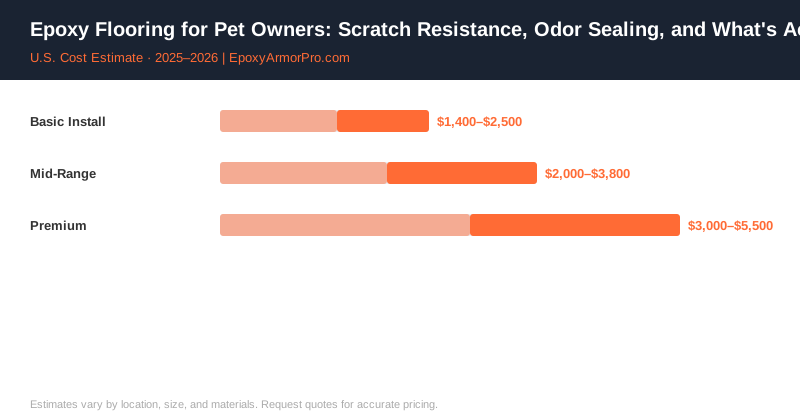
The cost drivers for a pet-optimized epoxy installation are the topcoat specification and anti-slip broadcast — modest additions to a standard installation.
| Space | Standard Epoxy | Pet-Optimized (satin + grit) | Polyaspartic Topcoat + Grit |
|---|---|---|---|
| 200 sq ft utility room | $600–$1,400 | $750–$1,700 | $1,000–$2,200 |
| 400 sq ft basement | $1,200–$2,800 | $1,500–$3,400 | $2,000–$4,400 |
| 600 sq ft main floor | $1,800–$4,200 | $2,250–$5,100 | $3,000–$6,600 |
| Full garage (500 sq ft) | $1,500–$3,500 | $1,900–$4,200 | $2,500–$5,500 |
The anti-slip broadcast and satin topcoat upgrade typically adds $0.75–$1.50 per square foot over a gloss standard finish. For a 400 sq ft space, that’s $300–$600 extra — a small premium for a floor that actually works for your household.
For large dogs and multi-dog households, the polyaspartic topcoat upgrade is worth budgeting. The improved abrasion resistance makes a meaningful difference in long-term appearance over 5–10 years.
Contractor Referral Disclaimer: EpoxyArmorPro is a contractor referral and cost information service, not a licensed flooring contractor. We connect consumers with independent, licensed, and insured contractors. We do not perform any flooring work directly. Cost estimates are averages based on market data and vary by location, project size, materials, and contractor. Always verify contractor licensing and insurance before hiring. Individual quotes may differ from estimates shown.