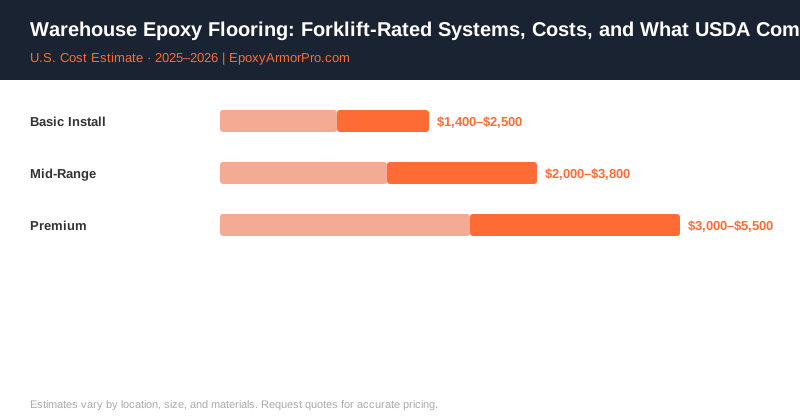
42% of warehouse floor failures trace back to the wrong coating system specified for the actual use — not poor installation. That’s from a 2023 industry survey by the Society for Protective Coatings. The floor that works perfectly under pedestrian and light pallet-jack traffic simply isn’t engineered for a 10,000-lb forklift running the same path 80 times a day.
If you’re coating a warehouse, distribution center, or industrial facility, the product spec matters far more than it does in any residential application. Here’s how to read those specs, what you’ll pay at scale, and what systems meet regulatory requirements for food and pharmaceutical facilities.
Why Warehouse Epoxy Is Different From Residential
Residential and light commercial epoxy is typically 10–15 mils thick when cured. A proper warehouse system starts at 20–30 mils and can go 60–125 mils for heavy forklift areas — that’s thick enough to feel it with your fingers.
The difference isn’t just thickness. Warehouse-grade systems use 100% solids formulations with higher compressive strength ratings. You’ll see specs like 10,000 PSI compressive strength as a minimum for forklift traffic. Compare that to a typical residential epoxy at 4,000–6,000 PSI and you understand why the residential product fails under industrial loads.
USDA-Compliant and FDA-Regulated Facility Requirements
If your warehouse handles food, pet food, pharmaceuticals, or other regulated products, your floor coating isn’t just a maintenance decision — it’s a compliance one.
USDA authorization: The USDA maintains a list of authorized floor coatings for use in federally inspected meat and poultry facilities. Authorized products must be seamless, non-absorbent, non-toxic when cured, and cleanable to reduce harborage of bacteria. Most require coved base transitions at walls.
FDA 21 CFR Part 117: For food manufacturing and warehousing under FDA jurisdiction, floors must be “smooth, durable, and cleanable.” Epoxy meets this requirement when properly specified and installed — bare concrete does not.
Pharmaceutical GMP: FDA-regulated pharmaceutical facilities typically require ESD (electrostatic dissipative) or anti-static coatings in areas where electronics or sensitive compounds are handled. Standard epoxy doesn’t provide this — you need a specifically formulated conductive epoxy with measured surface resistivity.
Chemical Resistance: Getting Specific
“Chemical resistant” is a marketing phrase. What matters is which chemicals and at what concentrations and exposure times.
| Chemical | Standard Epoxy | Chemical-Resistant Epoxy | Novolac Epoxy |
|---|---|---|---|
| Gasoline / petroleum | Fair (spot exposure only) | Good | Excellent |
| 10% sulfuric acid | Poor | Good | Excellent |
| Bleach / sodium hypochlorite | Good | Good | Excellent |
| MEK / acetone | Poor | Fair | Good |
| Hydraulic fluid | Good | Excellent | Excellent |
For chemical warehouses, battery charging areas, and facilities using aggressive cleaning chemicals, specify a novolac epoxy or a urethane cement system. Novolac epoxy costs roughly 30–50% more than standard epoxy but provides dramatically better acid and solvent resistance.
Cost Per Square Foot: How Scale Changes Everything
This is where warehouses differ most from residential: at scale, the economics flip dramatically. A 500 sq ft garage costs more per foot than a 50,000 sq ft warehouse because mobilization costs get spread across more square footage.
According to the Concrete Network, commercial and industrial epoxy installations average:
| Square Footage | Typical Cost Range (per sq ft) | Notes |
|---|---|---|
| Under 2,000 sq ft | $4–$7 | Mobilization cost dominates |
| 2,000–10,000 sq ft | $3–$5 | Standard warehouse, basic system |
| 10,000–50,000 sq ft | $2–$4 | Volume pricing, competitive bids |
| 50,000+ sq ft | $1.50–$3 | Large project, negotiated pricing |
| Heavy-duty / forklift rated (add-on) | +$1–$2/sq ft | Additional build coat thickness |
| Chemical-resistant novolac system | +$0.75–$1.50/sq ft | Premium chemistry |
| ESD / anti-static system | +$1–$2.50/sq ft | Requires ground planes |
A 20,000 sq ft warehouse with a standard 3-coat epoxy system in good condition concrete runs approximately $60,000–$90,000 installed. That same footage with a chemical-resistant system and line-striping adds $20,000–$30,000.
Surface Prep: The Factor That Determines Lifespan
Industrial concrete prep is not optional and it’s not a line item to cut. Shot-blasting — propelling steel shot at high velocity across the floor — is the industry standard for creating the surface profile needed for proper adhesion. ICRI guideline 310.2 specifies concrete surface profiles (CSP) of 3–5 for most industrial epoxy applications.
Diamond grinding is used around perimeter areas and where shot blasting can’t reach. Crack repair and joint filling must be completed before coating. Surface moisture must be tested (ASTM F2170 probe method is preferred for warehouses, especially temperature-controlled facilities).
Skimping on prep is how you get delamination at 2 years on a floor that should last 10–15.
Downtime Planning: This Is a Real Operations Issue
A warehouse shutdown for floor coating isn’t a weekend project. Here’s realistic planning:
- Shot-blasting and prep: 1–2 days for 20,000 sq ft
- Primer coat and cure: 8–12 hours
- Color/build coat and cure: 12–24 hours
- Topcoat and cure to foot traffic: 12–24 hours
- Return to forklift traffic: 72 hours minimum, 5–7 days preferred
Fast-cure polyaspartic systems can compress this to 24–48 hours total, but at a cost premium of 25–40% over standard epoxy. For facilities that can’t afford multi-day shutdowns, polyaspartic systems are worth the premium.
Line Striping, Safety Markings, and OSHA Compliance
OSHA 1910.22 requires that walking-working surfaces, aisles, and passageways be clearly marked where vehicle and pedestrian traffic mix. Most warehouses add line striping — forklift lanes, pedestrian walkways, hazard zones — as part of the coating project.
Line striping with epoxy paint runs $0.50–$1.50 per linear foot. A typical 20,000 sq ft warehouse might have 800–1,200 linear feet of markings, adding $400–$1,800 to the project. Do it while the floor is being coated — it’s far cheaper than mobilizing a second time.
Contractor Referral Disclaimer: EpoxyArmorPro is a contractor referral and cost information service, not a licensed flooring contractor. We connect consumers with independent, licensed, and insured contractors. We do not perform any flooring work directly. Cost estimates are averages based on market data and vary by location, project size, materials, and contractor. Always verify contractor licensing and insurance before hiring. Individual quotes may differ from estimates shown.