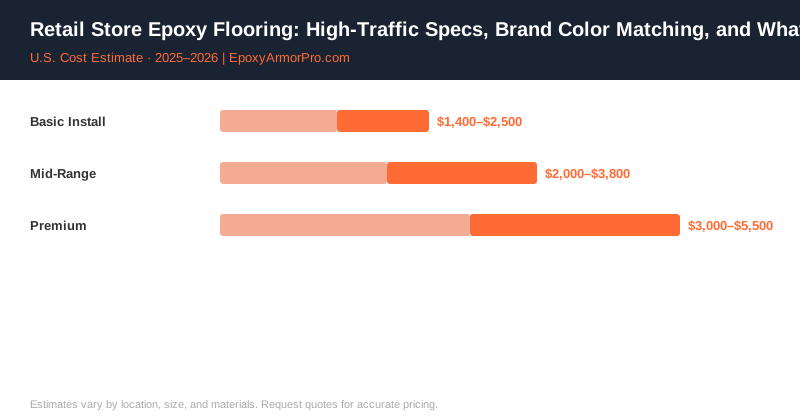
Your retail floor sees more traffic in a month than a typical home sees in a decade. A customer at a busy boutique or hardware store crosses 800–1,200 square feet of floor hundreds of times per day — plus rolling racks, pallet jacks, and point-of-sale equipment dragging across the surface constantly. The floor system that works in a residential garage simply won’t last in this environment without upgrades to the specification.
Here’s what “commercial-grade” actually means for retail, what you’ll pay for a properly specified system, and how to plan an installation around the revenue your store generates every day it’s closed.
What High-Traffic Commercial Spec Actually Means
Retail epoxy specifications differ from residential in two key areas: abrasion resistance and surface hardness.
Abrasion resistance is measured by the Taber Abraser test (ASTM D4060). Residential epoxy products typically show 50–100 mg weight loss per 1,000 cycles. Commercial-grade products spec 10–30 mg. That difference shows up over 3–5 years as the difference between a floor that still looks sharp and one that’s visibly worn through in the high-traffic paths.
Surface hardness is measured by Shore D or Rockwell hardness. Commercial systems targeting retail typically spec Shore D 75–85. Below that threshold, you’ll see permanent scuff marks from rubber-soled shoes and wheel marks from rolling racks within the first year.
Additionally, retail-grade topcoats use improved UV stabilizers to prevent ambering from store lighting (especially older fluorescent and halogen systems that concentrate UV). Ask for aliphatic rather than aromatic urethane topcoats — they hold color under continuous artificial lighting.
Brand Color Matching for Retail Environments
Retail brands increasingly specify their floor color as part of store design standards. A franchise or brand-licensed retailer often has a defined floor color code in their brand standards manual — sometimes a RAL color, sometimes a custom color chip from their design team.
Professional epoxy contractors can color-match to virtually any specified color using pigment systems with high-accuracy colorimetry. The process:
- Client provides the color specification (RAL code, Pantone number, physical chip, or brand standards document)
- Contractor submits color formulation to the coating manufacturer
- Lab-generated color chip is confirmed against specification before production
- First pour is inspected under the store’s actual lighting conditions (critical — color reads differently under fluorescent, LED, and daylight)
Color-matched custom formulations typically add $0.25–$0.75 per square foot over standard color palettes. For franchise locations with strict brand standards, this cost is simply part of the spec — budget it accordingly.
Important caveat on color accuracy: Epoxy color can shift slightly from the wet mixed state to the fully cured state, and continues to develop for 7–10 days post-application. Require a full-cure sample chip confirmation before a large-format installation. Touching up mismatched color after full installation is far more expensive than getting confirmation upfront.
VOC Compliance and Store Closure Planning
This is where retail epoxy installations require careful advance planning. Epoxy application generates VOC emissions during application and initial cure. For a retail space, this means:
Who can be in the building: Nobody except installers and ventilation equipment operators. No employees, no early morning deliveries, no overnight stocking. The space must be clear.
Ventilation requirements: Building HVAC should be set to maximum fresh air exchange. Temporary industrial fans typically supplement store HVAC during and after application. OSHA requires mechanical ventilation when solvent-based coatings are applied in enclosed spaces.
Odor dissipation timeline: Even after the coating is dry to traffic, residual odor can affect customer experience. For 100% solids epoxy, most odor dissipates within 24–48 hours. For solvent-based systems (less common in retail but sometimes used for specific performance requirements), allow 72–96 hours.
| System Type | VOC Level | Closure Time (full cure) | Return to Customer Traffic |
|---|---|---|---|
| Water-based epoxy | Very low | 24–48 hours | 24 hours |
| 100% solids epoxy (standard) | Low-moderate | 48–72 hours | 48 hours |
| Polyaspartic topcoat system | Low | 24 hours | 24 hours |
| Solvent-based urethane topcoat | Moderate-high | 72–96 hours | 72 hours |
For high-revenue retail locations, polyaspartic systems — despite their cost premium — often pay for themselves in reduced closure time. A store doing $5,000/day in sales saves $10,000–$15,000 in lost revenue by using a 24-hour return-to-traffic system versus a 72-hour standard epoxy.
What Retail Epoxy Costs for Typical Store Footprints
According to the Concrete Network, commercial epoxy flooring for retail applications averages $4–$9 per square foot installed, depending on system specifications and store conditions.
| Store Size | Standard System ($4–$6/sq ft) | Premium System ($6–$9/sq ft) | Notes |
|---|---|---|---|
| 500 sq ft (small boutique) | $2,000–$3,000 | $3,000–$4,500 | High mobilization relative to area |
| 1,200 sq ft (mid-size retail) | $4,800–$7,200 | $7,200–$10,800 | Standard range |
| 2,500 sq ft (larger store) | $10,000–$15,000 | $15,000–$22,500 | Volume begins improving unit cost |
| 5,000 sq ft (big box anchor) | $18,000–$30,000 | $27,000–$45,000 | Competitive volume pricing |
| Custom color match add-on | +$0.25–$0.75/sq ft | — | Per branded spec |
Surface Prep in Retail Spaces
Retail concrete floors often have challenges that residential slabs don’t:
Previous coating removal: Most retail spaces have had a prior floor covering — vinyl composition tile (VCT), sheet vinyl, ceramic tile, or an old coating. VCT adhesive is the most common and most problematic. Black mastic adhesive from VCT requires shot-blasting or grinding to remove, adding $0.75–$1.50 per square foot and significant dust management in the space.
Control joints: Retail floors often have saw-cut control joints every 10–15 feet. These need to be cleaned and filled with polyurea joint filler before coating. Joints left open will telegraph through the epoxy as cracks within months under heavy cart traffic. Budget $1–$3 per linear foot for joint filling.
Moisture testing: Retail slabs — especially ground-floor spaces — can have elevated moisture vapor emission. ASTM F1869 calcium chloride testing is standard before any coating for commercial projects.
Scheduling Around Retail Operations
Every day your store is closed for flooring is revenue gone. Here’s how experienced contractors schedule retail installations to minimize impact:
- Phase the work: Coat half the store while the other half stays open, using temporary barriers. More complex to execute but keeps you at 50% revenue.
- Holiday blackout periods: Avoid scheduling near Black Friday, holiday season, or other peak periods. Delays — from weather, concrete surprises, or product availability — are costly near peak revenue windows.
- Overnight schedules: Some contractors work overnight shifts to apply and let cure, targeting reopening by morning. Polyaspartic systems make this feasible.
- Weekend closures: For Monday reopenings, start Friday night. A fast-cure polyaspartic system applied Saturday AM is typically ready for customer traffic by Sunday PM.
Contractor Referral Disclaimer: EpoxyArmorPro is a contractor referral and cost information service, not a licensed flooring contractor. We connect consumers with independent, licensed, and insured contractors. We do not perform any flooring work directly. Cost estimates are averages based on market data and vary by location, project size, materials, and contractor. Always verify contractor licensing and insurance before hiring. Individual quotes may differ from estimates shown.