Standard epoxy on an outdoor patio will look great for about six months. Then it turns yellow, chalks out, and starts peeling at the edges. That’s not a failure of the installer — it’s a failure of the product spec. Standard epoxy is simply not UV-stable.
The good news: there are exterior coating systems that hold up beautifully for 10–15 years on a patio. They just aren’t the same product used inside a garage. Here’s what works, what it costs, and what climates change the calculation.
Why Standard Epoxy Fails Outdoors
Epoxy’s weakness is ultraviolet light. UV radiation breaks down the chemical bonds in standard epoxy resin, causing what coatings professionals call “ambering” — a yellowing and chalking of the surface. Direct sun exposure accelerates this dramatically. In the Sun Belt, a standard epoxy patio can show significant UV degradation in as little as 3–4 months.
Beyond UV, exterior concrete faces thermal cycling. A concrete slab that goes from 20°F overnight to 80°F in afternoon sun expands and contracts with each cycle. Standard epoxy, which is relatively rigid, can’t flex with those movements and begins to crack and delaminate at the perimeter.
The solution isn’t to skip coating — it’s to use the right coating from the start.
The Right Exterior System: Polyaspartic Topcoats
Polyaspartic coatings were developed specifically to address epoxy’s outdoor limitations. They’re aliphatic urethanes — a chemistry that’s inherently UV-stable. Where standard epoxy amber-yellows in months, a quality polyaspartic holds its color for years.
For exterior patios, professionals typically use a two-system approach:
- Epoxy primer/basecoat: Penetrates the concrete and provides adhesion and chemical resistance
- Polyaspartic topcoat: Provides UV stability, color retention, and abrasion resistance
The epoxy never sees UV because it’s protected by the polyaspartic above it. This hybrid system gives you the best of both chemistries.
Anti-Slip Requirements for Exterior Surfaces
An outdoor patio gets wet. Rain, dew, morning moisture from the lawn — a smooth, glossy coating on exterior concrete is a slip hazard and, in many jurisdictions, a code compliance issue.
The ADA requires a minimum coefficient of friction (COF) of 0.6 for accessible routes, including outdoor surfaces. Most insurance carriers and HOA guidelines also specify minimum slip resistance for patios and pool decks. Standard broadcast of aluminum oxide into the topcoat solves this cleanly — it adds texture without compromising appearance and typically adds $0.50–$1.00 per square foot.
For pool-adjacent patios or areas with significant water exposure, contractors sometimes use a heavier aggregate broadcast or a rubberized topcoat that provides both anti-slip and cushioning underfoot.
Freeze-Thaw Climates: This Changes Everything
If you’re in the Midwest, Northeast, or any region that sees regular freeze-thaw cycles, exterior concrete coating requires specific attention to two issues.
Moisture vapor: Concrete in freeze-thaw climates often has higher residual moisture. Coating over concrete with elevated moisture vapor emission causes delamination — typically within the first winter. A proper moisture vapor barrier primer is non-negotiable in these climates.
Concrete condition: Freeze-thaw damage (spalling, scaling, cracking) must be addressed before coating. Trying to coat over deteriorating concrete is applying a finish coat to a crumbling substrate. Repair the concrete first, let it cure fully, then coat.
According to the Portland Cement Association, concrete exposed to repeated freeze-thaw cycles without proper air-entrainment can lose significant surface integrity within 10–15 freeze-thaw cycles. If your patio concrete has visible scaling, a coating will hide the problem temporarily but won’t stop the damage beneath.
What Patio Epoxy Costs: The $4–$8 Range Broken Down
According to the Concrete Network, exterior decorative coatings for patios and pool decks average $4–$8 per square foot professionally installed. Here’s what moves the number within that range:
| System Type | Cost per Sq Ft (installed) | UV Stable | Notes |
|---|---|---|---|
| Epoxy basecoat only (aromatic) | $2–$4 | No | Not recommended for full sun |
| Epoxy + aliphatic polyaspartic topcoat | $4–$7 | Yes | Standard exterior recommendation |
| Full polyaspartic system (no epoxy base) | $5–$8 | Yes | Fastest cure, premium cost |
| Decorative chip broadcast + poly topcoat | $5–$9 | Yes | Popular patio aesthetic |
| Metallic/custom exterior system | $8–$14 | Yes | Designer look, premium coating |
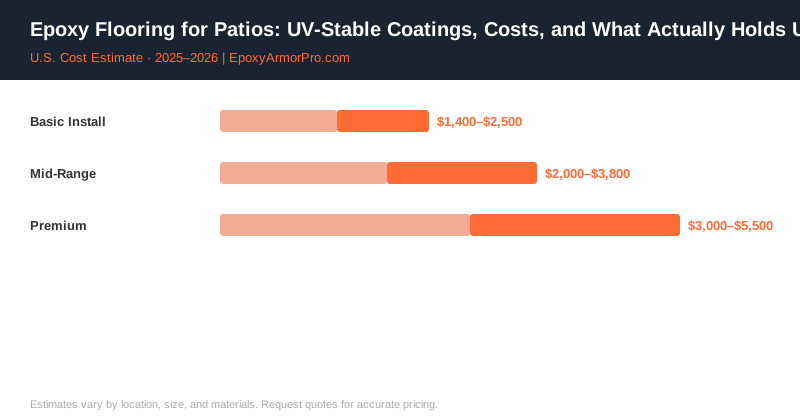
A typical 200–400 sq ft back patio with a two-coat polyaspartic system runs $800–$3,200 installed. Larger patios (600–800 sq ft) see better per-foot pricing as mobilization costs get distributed.
Surface Condition and Prep Costs
Exterior concrete tends to be in worse shape than interior slabs. Decades of freeze-thaw, lawn chemicals, and sun damage mean more prep work. Budget for:
- Crack repair: $1–$3 per linear foot for hairline cracks filled with polyurea
- Spalling repair: $3–$6 per square foot for areas of surface scaling
- Pressure washing and degreasing: Usually included in contractor bids, but confirm
- Diamond grinding: Standard for proper adhesion profile; expect 1–2 hours per 100 sq ft
If your patio has existing paint, stain, or a previous failed coating, removal adds significant cost. Grinding off an old coating layer can add $0.75–$1.50 per square foot.
Pool Decks: A Special Case
Pool decks are exterior patios with additional requirements. Constant moisture, pool chemicals (especially chlorine and stabilizers), bare feet, and safety concerns around the pool edge all factor in.
For pool surrounds, contractors typically specify:
- Cementitious or polymer-modified overlays as the base (more moisture-tolerant than pure epoxy)
- Aliphatic polyaspartic topcoat for UV stability and chemical resistance
- Heavy anti-slip aggregate — more broadcast than a standard patio
- Lighter colors to reflect heat and keep the surface cooler underfoot
Pool deck systems typically run $6–$12 per square foot installed due to the additional complexity and premium product requirements.
Maintenance: What the Long-Term Looks Like
A properly installed exterior polyaspartic system is low-maintenance but not zero-maintenance. Expect to:
- Sweep and hose off regularly — outdoor debris is harder on coatings than indoor dust
- Reapply topcoat every 5–10 years depending on sun exposure and traffic — this is a fraction of the original installation cost
- Avoid harsh degreasers — pH-neutral cleaners only; aggressive solvents can dull the topcoat finish
Compared to painted concrete (repaints every 2–3 years), pavers (weed maintenance, re-leveling sand), or wood decking (staining, sealing, board replacement), a polyaspartic patio system has genuinely competitive long-term maintenance costs.
Contractor Referral Disclaimer: EpoxyArmorPro is a contractor referral and cost information service, not a licensed flooring contractor. We connect consumers with independent, licensed, and insured contractors. We do not perform any flooring work directly. Cost estimates are averages based on market data and vary by location, project size, materials, and contractor. Always verify contractor licensing and insurance before hiring. Individual quotes may differ from estimates shown.