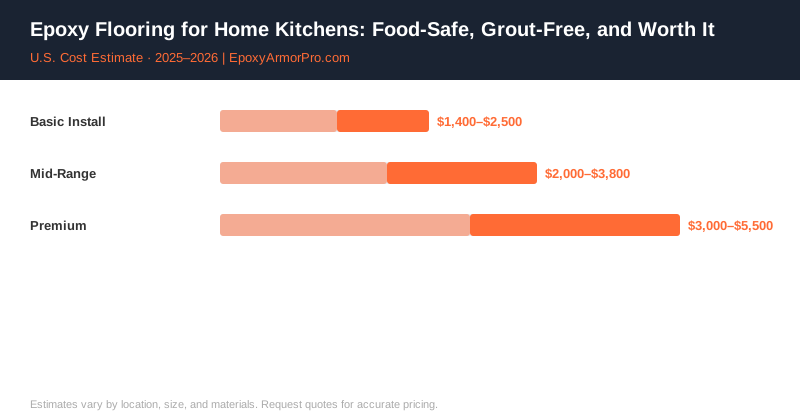
Your tile grout is probably the dirtiest part of your kitchen — and you scrub it every week. That’s the pitch that’s converting homeowners to epoxy faster than any other argument. A seamless kitchen floor with no grout lines, no cracked tiles to catch crumbs, and a surface you can mop in 30 seconds flat.
But not all epoxy is kitchen-appropriate. The coatings that work great in a garage aren’t automatically safe around food prep areas. Here’s exactly what to look for, what it costs, and whether it’s the right call for your kitchen.
Is Epoxy Actually Food-Safe?
Yes — but only the right kind. Standard garage epoxy isn’t formulated for food-contact surfaces. What you want for a kitchen is a 100% solids, water-based or FDA-compliant epoxy that’s fully cured before food prep resumes.
The key word is cured, not just dry. Epoxy that’s dry to the touch can still be releasing low-level volatile compounds. Most professional kitchen-grade coatings reach full chemical cure in 5–7 days at 70°F. That’s when it’s truly food-safe. Rushing the process is where homeowners get into trouble.
Kitchen Epoxy vs. Tile: The Real Comparison
Tile has three problems in kitchens: grout lines that collect bacteria, the hollow-click sound when a section lifts, and the grout maintenance burden that never ends. According to the Tile Council of North America, grout should be resealed every 1–2 years to prevent staining and microbial growth — a task most homeowners simply don’t do.
Epoxy solves all three. It’s seamless, so there’s nowhere for grease and bacteria to pool. It’s solid-surface bonded to the concrete or subfloor beneath, so no hollow spots. And maintenance is a wet mop and done.
The trade-offs are real, though. Epoxy is harder underfoot than tile — you’ll feel it on a 3-hour cooking session. It can show scratches from dropped cast iron or dragged appliances. And once it’s down, refinishing means grinding the whole floor, not just swapping a tile.
| Flooring Option | Installed Cost (per sq ft) | Lifespan | Grout Lines |
|---|---|---|---|
| Ceramic tile | $5–$14 | 20–50 years | Yes |
| Luxury vinyl plank | $4–$12 | 10–25 years | No |
| 100% solids epoxy | $4–$10 | 15–25 years | No |
| Polyaspartic topcoat system | $7–$12 | 20+ years | No |
Anti-Slip Requirements: Don’t Skip This
A kitchen floor that looks beautiful but gets slick when wet is a liability. The Americans with Disabilities Act recommends a minimum coefficient of friction (COF) of 0.6 for wet surfaces. Most standard epoxy topcoats don’t hit that without additives.
The fix is straightforward: aluminum oxide or silica carbide broadcast into the topcoat before it cures. Your contractor should be doing this automatically in any kitchen application. If they quote you a smooth, glassy finish for a kitchen floor, ask specifically about slip additives — or walk.
Anti-slip broadcast adds roughly $0.50–$1.00 per square foot to the job cost, which is absolutely worth it.
What Drives the $4–$10 Per Square Foot Range
The Concrete Network estimates kitchen epoxy averages $6–$8 per square foot for a professional two-coat system in a typical 150–250 sq ft kitchen. Here’s what moves the needle:
Surface condition: A kitchen with old vinyl adhesive, moisture issues, or cracked concrete subfloor needs significantly more prep work. Shot-blasting or grinding to remove adhesive residue can add $1–$2 per square foot.
Number of coats: A budget single-coat system starts around $4/sq ft. A proper primer + color coat + clear topcoat with anti-slip typically runs $6–$9. Adding a metallic or decorative flake finish pushes you toward $10+.
Cabinets and obstacles: More cut-in work around cabinets, islands, and appliances means more labor. An open, galley-style kitchen costs less per foot to coat than a complex kitchen with an island, peninsula, and multiple doorways.
Downtime: Professional kitchen epoxy means you’re out of your kitchen for 24–72 hours minimum, sometimes longer. Some homeowners pay a premium for fast-cure polyaspartic systems that get them back in the kitchen in 24 hours.
Installation Over Existing Flooring
Can epoxy go over tile? Sometimes — but it’s tricky. A good contractor will:
- Check that all tiles are firmly bonded (tap-test every section)
- Grind or scarify the tile surface for mechanical adhesion
- Apply a skim coat to fill grout lines before the color coat
- Apply a thicker build coat to level any remaining texture
Going over tile adds $1–$2 per square foot and works best when the tile is in excellent condition. If tiles are cracked, hollow, or improperly bonded, it’s cheaper and more durable long-term to demo them first.
How Long Will Kitchen Epoxy Last?
In a residential kitchen with proper installation and reasonable care, expect 15–20 years before you’d need refinishing. According to HomeAdvisor, the average homeowner refinishes or replaces kitchen flooring every 12–15 years — so a well-installed epoxy system actually outpaces most competing options.
Heavy abuse — dragging heavy appliances, dropping cast iron repeatedly, using harsh bleach cleaners — shortens that considerably. Use furniture pads, a rubber mat in high-drop zones (in front of the stove), and pH-neutral floor cleaners and you’ll be in great shape.
Contractor Referral Disclaimer: EpoxyArmorPro is a contractor referral and cost information service, not a licensed flooring contractor. We connect consumers with independent, licensed, and insured contractors. We do not perform any flooring work directly. Cost estimates are averages based on market data and vary by location, project size, materials, and contractor. Always verify contractor licensing and insurance before hiring. Individual quotes may differ from estimates shown.