Nobody moves into an HOA community thinking they’ll need written permission to coat their own garage floor. Then they get the violation notice — or worse, get stuck paying for removal after an unapproved install.
The reality is that HOA oversight of garage interiors is more common than most homeowners expect, particularly in communities with attached garages or shared garage structures. Here’s how to navigate the approval process, what to include in your request, and what HOAs are typically looking for.
Do HOAs Actually Control Garage Floors?
Yes — in many communities. The extent of HOA authority over your garage interior depends on your CC&Rs (Covenants, Conditions & Restrictions) and your community’s specific rules.
Single-family detached homes with attached garages: HOAs typically have authority over exterior appearance (including the garage door and anything visible when the door is open) and sometimes interior finishes in common-wall situations. About 35–45% of HOA communities in the US have some form of interior garage finish requirement or restriction, according to the Community Associations Institute (CAI).
Townhomes and condos with shared garage structures: HOA authority is much broader here. In shared-structure garages (where your garage unit is part of a larger building), virtually all modifications — including floor coatings — require board approval. The floor may technically be common element property.
Communities with garage appearance standards: Some HOAs have explicit requirements that garage floors must be maintained in a certain condition, or that visible portions of the garage must meet an appearance standard. These communities are actually more likely to welcome — or even require — epoxy, because it looks more maintained than bare concrete.
Common HOA Restrictions on Garage Flooring
When HOAs do have rules about garage floors, here’s what they typically restrict:
Color and pattern: Some HOAs require neutral, non-reflective finishes in visible garage areas. Bright colors, metallic finishes, and high-gloss coatings that reflect light outside the garage when the door is open may be restricted. Standard gray or tan chip systems usually have no issue.
Contractor licensing requirements: Many HOA rules require that all contractors working on the property be licensed and carry minimum liability insurance. This is standard for reputable epoxy contractors anyway, but confirm your contractor can provide certificates of insurance.
Noise and working hours: Installation typically involves diamond grinding or shot blasting — equipment that’s louder than most residential work. HOA communities with noise ordinances may restrict this to weekday business hours or specific time windows.
Chemical storage and disposal: Some HOAs restrict the storage of two-part epoxy components during installation. This is rarely an enforcement issue, but worth knowing.
Shared garage structures: In condo communities, any modification to a shared structural element (floor slab) may require engineering review in addition to board approval.
What to Include in Your HOA Approval Request
A well-prepared approval request gets approved faster and with fewer questions. Here’s what to include:
Product specification sheet: Ask your contractor for the manufacturer data sheet for the epoxy product they’re using. This shows it’s a standard commercial coating, not an experimental material.
Finish color/sample: If the HOA has appearance standards, provide a physical sample or photo of the final chip system color you’re choosing. Neutral tones (gray, tan, salt-and-pepper) are almost universally approved.
Contractor credentials: License number, certificate of liability insurance, and any manufacturer certifications. Most professional epoxy contractors have these ready.
Scope of work description: A brief written description — “diamond grinding of existing concrete surface, application of primer coat, color coat with chip broadcast, and polyaspartic topcoat” — is more professional than vague descriptions and reduces back-and-forth.
Before/after photos of comparable work: If your contractor has portfolio photos from similar community types, include them. HOA boards respond to visual references.
Completion and cure timeline: Mention that the garage will be unavailable for 48–72 hours during installation and cure. If you share driveway access with a neighbor, note any parking plan.
| HOA Approval Request Component | Purpose | Typical Format |
|---|---|---|
| CC&R review + determination of need | Confirm approval is required | Self-research |
| Written request to architectural committee | Formal application | 1-page letter or HOA form |
| Product data sheet | Shows standard commercial product | PDF from contractor |
| Color sample or finish photo | Visual confirmation | Photo or physical chip sample |
| Contractor license + insurance | Compliance with contractor requirements | Certificates from contractor |
| Work timeline | Shows minimal disruption | 2–3 sentence description |
Dealing with Shared Garages in Condo or Townhome Communities
This is where it gets more complicated. In shared-structure garages — where your parking space is one of many in a larger building — the floor slab is often common element property owned by the HOA, not you individually. Coatings on common element property may require board vote, not just committee approval.
Steps for shared garage structures:
- Confirm with your management company whether the floor slab is common element or individual unit property.
- If it’s common element, your modification may need to go to a board vote rather than just architectural review committee.
- Request to add the item to the next board meeting agenda.
- Bring documentation of the product, contractor credentials, and maintenance plan.
Some HOAs in shared-garage communities will approve individual unit coatings as a standard modification; others require that epoxy be done in phases across all units to maintain visual consistency. Knowing which situation you’re in before you start saves significant time.
When Your HOA Says No
If your HOA denies your request, you have options:
Appeal: Most CC&Rs have an appeal process for architectural review decisions. Request the specific reason for denial in writing, address each concern, and resubmit. A rejection for “color concerns” that you address with a neutral sample often gets reversed.
Request variance: If your situation has specific circumstances (moisture management need, accessibility requirement, resale preparation), document them and request a variance from the standard rules.
Work with the board directly: If you have a specific HOA board member who’s supportive, a direct conversation before the formal review often surfaces concerns you can address upfront.
Check if a rule exists: Some HOA managers deny modifications based on “policy” that isn’t actually in the CC&Rs. Get the specific section number they’re citing. “We don’t allow that” isn’t the same as “Section 4.7 prohibits that.”
Standard vs. Premium Finishes for HOA Communities
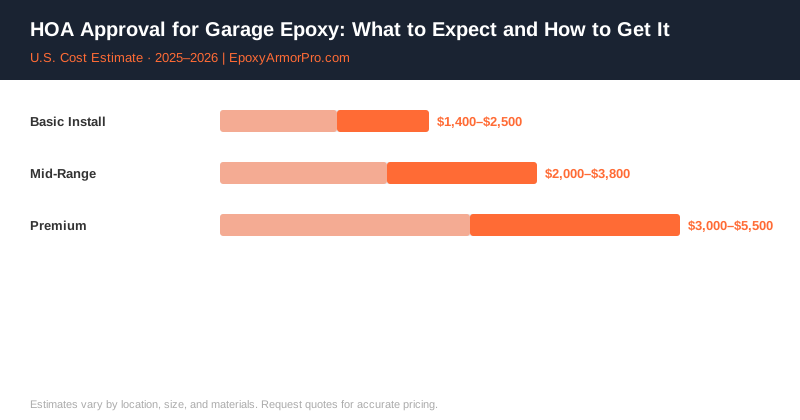
One practical note: for HOA communities with appearance standards, standard chip systems consistently get approved faster than premium metallic or custom designs. The visual predictability of a gray or tan chip floor reads as “maintenance upgrade” to a board. A custom metallic with swirling color reads as “artistic modification” and triggers more scrutiny.
Unless you’re in a high-end community where premium finishes are common, a solid full-broadcast chip system in a neutral palette is your fastest path to approval and the most appropriate choice for an HOA environment.
Contractor Referral Disclaimer: EpoxyArmorPro is a contractor referral and cost information service, not a licensed flooring contractor. We connect consumers with independent, licensed, and insured contractors. We do not perform any flooring work directly. Cost estimates are averages based on market data and vary by location, project size, materials, and contractor. Always verify contractor licensing and insurance before hiring. Individual quotes may differ from estimates shown.