Your Tesla Model 3 weighs 4,048 pounds. Your Ford F-150 Lightning weighs 6,015. That’s not just a heavy vehicle — it’s a heavy vehicle with a 100+ kWh battery pack underneath it, battery management coolant running through dozens of feet of tubing, and a charging system generating heat every night while it sits on your floor.
EV garages have different floor demands than ICE garages. Most epoxy contractors don’t talk about this unless you ask. Here’s what you actually need.
The Battery Coolant Problem
This is the issue most EV owners don’t think about until there’s a puddle. Battery thermal management systems in modern EVs use liquid coolant — ethylene glycol, propylene glycol, or proprietary blends — to keep the battery pack within operating temperature range. That coolant runs through aluminum tubing on the underside of the battery enclosure.
Battery coolant leaks are uncommon but not rare. A pinhole leak, a loose fitting after a collision, or a degraded seal from an older vehicle can drip coolant onto the floor. Standard epoxy topcoats are generally resistant to glycol-based coolants, but not indefinitely. Prolonged pooling will eventually soften standard polyurethane topcoats and cause discoloration or minor surface degradation.
What handles battery coolant reliably: polyurea or aliphatic polyaspartic topcoats. These have significantly higher chemical resistance than standard polyurethane-over-epoxy systems. They don’t soften under glycol exposure and won’t stain. For EV garages, specifying a polyaspartic or polyurea topcoat (rather than polyurethane) is a small upcharge — typically $0.50–$1.50 per square foot — that’s worth it.
Charging Station Area: Heat and Abrasion
Level 2 home chargers (the standard 240V EVSE units that deliver 30–50 miles per hour of charge) don’t generate significant radiant heat at floor level. The charger itself produces heat, but it’s mounted to the wall, not the floor.
What does affect your floor in the charging area:
Cord traffic. Every time you move the charging cable across the floor, you’re dragging it. Over months and years, charging cords wear a path in any coating. The area directly below the cord plug-in is higher-traffic than the rest of the floor.
Tire placement. EVs often have fixed parking positions defined by the charger cord length. That means the same tire contact patches are in the same spots every single night. Hot tire pickup — where a warm tire bonds slightly to a lower-quality epoxy surface and pulls coating fibers when the car moves — is more likely in fixed parking positions than in a garage with varied use.
The solution: full-broadcast chip systems in the parking zone. The chip/flake broadcast adds thickness and hardness to the surface layer and dramatically reduces hot tire pickup. 100% solid epoxy with a full broadcast and a polyaspartic topcoat handles tire contact better than any other standard residential coating system.
EV Weight: Does It Matter for Epoxy?
The extra weight of EV battery packs raises a reasonable question: can your floor coating handle it?
Short answer: yes, with the right system. A properly installed 100% solid epoxy system at 15–20 mils total thickness is rated for tens of thousands of pounds per square foot in static load. The weight of an F-150 Lightning on a fully cured professional epoxy floor is not a concern.
What weight does affect is the quality of the substrate — your concrete — not the coating. If your concrete slab has cracks, inadequate thickness, or poor subbase support, a heavy vehicle can cause those issues to worsen. Epoxy won’t prevent concrete movement. Before any EV garage coating job, it’s worth having the contractor assess the slab condition, particularly if you’re parking a vehicle that’s 2,000+ pounds heavier than what the garage was designed for.
DC Fast Charging at Home: Is It Different?
A small number of homeowners are installing DC fast charging equipment (Level 3 / DCFC) at home — 80+ amp circuits delivering 150–200+ kW. These systems generate more heat than standard Level 2 EVSE.
For floor purposes, the relevant heat comes from the equipment and the cable, not the floor surface directly. No residential epoxy floor coating is at risk from Level 3 charger ambient heat — unless the charger has a physical defect and is generating heat in direct contact with the floor surface, which would be an equipment failure, not a coating specification issue.
The bigger consideration with high-voltage charging equipment is the electrical environment: static dissipation. For commercial or industrial EV charging facilities, static-dissipative epoxy coatings are sometimes specified. For residential Level 2, this is generally not needed.
Cost for an EV-Optimized Garage Floor
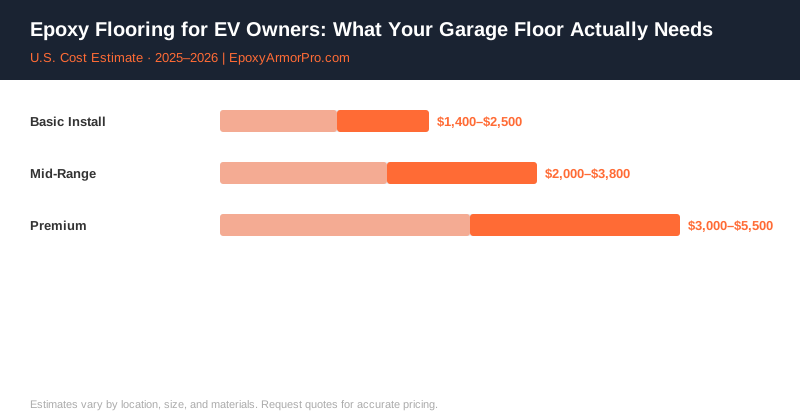
| Package | What’s Included | Cost (400 sq ft, 2-car garage) |
|---|---|---|
| Standard epoxy system | Epoxy primer + color coat + polyurethane topcoat | $1,600–$2,800 |
| EV-optimized system | Vapor primer + epoxy base + full-chip broadcast + polyaspartic topcoat | $2,400–$4,200 |
| Premium EV system | Above + anti-static additive + non-slip aggregate + accent striping | $3,200–$5,500 |
The upgrade from a standard system to an EV-optimized system typically adds $600–$1,400. For a vehicle that cost $40,000–$80,000, that’s a reasonable floor protection investment.
What to Ask Your Contractor
Most residential epoxy contractors don’t ask whether you have an EV. You need to tell them and then ask specific questions:
- “What topcoat do you use, and how does it hold up to glycol-based coolants?”
- “Is your chip system full-broadcast or partial? I want full broadcast for hot tire resistance.”
- “What’s the surface profile you’re putting down for tire grip?”
- “Do you offer an anti-static additive for the parking zone?”
A contractor who’s knowledgeable will engage with these questions directly. One who gives you vague answers or says “all our installs handle EVs fine” without specifics isn’t the right contractor for your job.
For comparison of overall floor systems, our garage epoxy flooring guide covers the full range of coating options in more depth.
Contractor Referral Disclaimer: EpoxyArmorPro is a contractor referral and cost information service, not a licensed flooring contractor. We connect consumers with independent, licensed, and insured contractors. We do not perform any flooring work directly. Cost estimates are averages based on market data and vary by location, project size, materials, and contractor. Always verify contractor licensing and insurance before hiring. Individual quotes may differ from estimates shown.