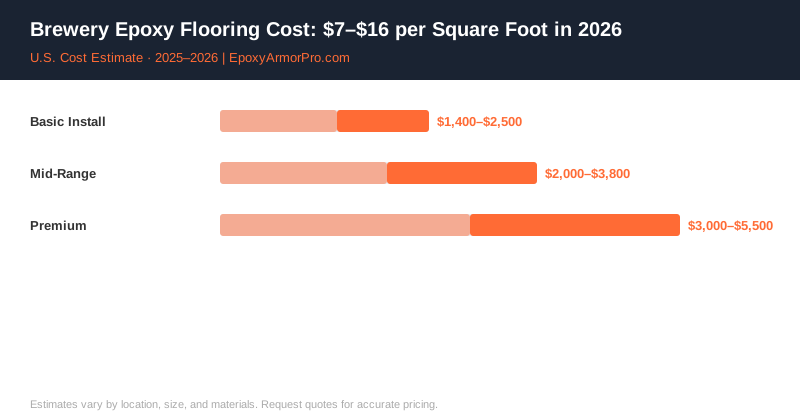
Here’s the number that surprises most new brewery owners: a 2,000-square-foot brewhouse floor can run $20,000–$32,000, roughly double what the same square footage would cost as a warehouse floor. It’s not a markup. It’s the chemistry.
Breweries run caustic and acidic cleaning agents through Clean-in-Place (CIP) systems nearly every day. Standard epoxy holds up fine against light traffic and the occasional spill, but it degrades quickly under repeated exposure to sodium hydroxide and peracetic acid — the two workhorse chemicals in most brewery sanitation programs. Get the coating system wrong, and you’re looking at a floor that’s pitting and delaminating within 18 months.
Why Chemical Resistance Drives the Price
The International Concrete Repair Institute has long identified chemical attack as one of the leading causes of premature coating failure in food and beverage production facilities, right alongside moisture-related failure. A standard epoxy topcoat simply isn’t formulated to hold up against sustained caustic exposure. Most brewery floor specifications call for a novolac epoxy or urethane cement system — both significantly more expensive per gallon than standard 100% solids epoxy, and both requiring more experienced installation crews.
| Area / Zone | Recommended System | Cost per Sq Ft |
|---|---|---|
| Brewhouse floor (kettles, mash tun) | Urethane cement, chemical-resistant | $10–$16 |
| Fermentation cellar | Novolac epoxy | $8–$13 |
| Packaging/canning line | Standard chemical-resistant epoxy | $7–$11 |
| Taproom / front of house | Decorative epoxy or metallic epoxy | $5–$9 |
| Cove base (per linear ft) | Integral coved transition | $10–$18 |
| Full 2,000 sq ft brewhouse project | Urethane cement system | $20,000–$32,000 |
Slope, Drains, and Standing Liquid
Beer production generates a lot of liquid on the floor — wort spills, wash-down water, condensation from cold cellars. A brewery floor needs aggressive slope to drains, typically 1/4 inch per foot minimum, and drains sized for high-volume flow. If the existing slab doesn’t slope correctly, expect an added cost for self-leveling underlayment before coating, usually $2–$4 per square foot depending on how much correction is needed.
Thermal Cycling in the Cellar
Fermentation and cold-storage areas cycle between ambient temperature and 34–38°F regularly as staff move in and out. That thermal cycling stresses a coating over time, particularly at the transition zones near cooler doors. A flexible urethane cement handles this far better than rigid epoxy, which is one reason cellar floors often use a different system than the brewhouse proper.
What Drives Cost Up or Down
The Decorative Concrete Institute notes that surface prep quality is the single biggest predictor of coating longevity in industrial food and beverage settings — more so than the coating brand itself. A brewery on an older slab with prior coating failures will need full mechanical removal (shot-blasting or diamond grinding down to bare concrete), adding $1.50–$3 per square foot before any new coating goes down. New construction breweries pouring a fresh slab can budget for coating alone, without the removal premium.
Questions to Ask Your Contractor
- What system are you specifying for the brewhouse versus the taproom, and why?
- Is the coating rated for sustained caustic (NaOH) exposure, not just occasional contact?
- How will you handle drain slope if the existing slab doesn’t meet 1/4 inch per foot?
- What’s the cove base detail at cooler and cellar entries?
- What warranty do you offer against chemical-related coating failure specifically?
Contractor Referral Disclaimer: EpoxyArmorPro is a contractor referral and cost information service, not a licensed flooring contractor. We connect consumers with independent, licensed, and insured contractors. We do not perform any flooring work directly. Cost estimates are averages based on market data and vary by location, project size, materials, and contractor. Always verify contractor licensing and insurance before hiring. Individual quotes may differ from estimates shown.