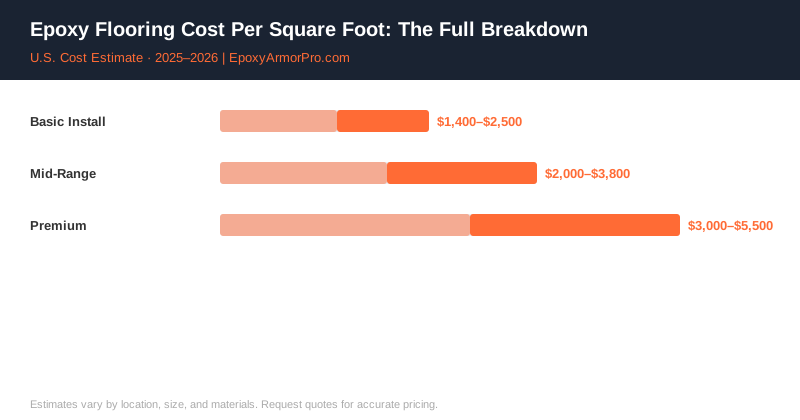
A 400-square-foot garage floor can run you $1,200 — or $4,800 — for essentially the same epoxy coating. That $3,600 difference isn’t contractor markup. It’s real differences in product quality, surface prep, and system thickness. Understanding what’s behind those numbers is the only way to avoid paying too much or getting burned by a lowball bid.
Here’s the honest breakdown.
The $3–$12 Range Explained
Epoxy flooring quotes span a wide range because “epoxy flooring” isn’t one thing. It’s a category that includes everything from thin single-coat paint-and-chips systems to heavy industrial multilayer floors. According to Concrete Network, most residential epoxy installations fall between $3 and $7 per square foot for standard systems, with premium decorative or high-build systems reaching $10–$12.
The three biggest cost drivers:
- Product grade — big-box store epoxy vs. 100% solid professional-grade coatings
- Surface prep — how much grinding, crack repair, and moisture testing is needed
- System layers — one coat vs. primer + basecoat + topcoat + flakes + sealer
A homeowner who shops on price alone often gets a one-coat system over minimal prep. It looks fine for six months. Then it starts peeling.
Material Costs: DIY vs. Pro Products
This is where the numbers get interesting. The materials you can buy as a homeowner and the materials a contractor uses are not the same.
| Product Type | Cost Per Gallon | Coverage | System Cost Per Sq Ft |
|---|---|---|---|
| Big-box 1-part epoxy paint | $30–$50 | 250–300 sq ft | $0.25–$0.40 |
| Box-store 2-part epoxy kit | $80–$120 | 200–250 sq ft | $0.50–$0.75 |
| Professional 100% solids epoxy | $120–$180 | 150–200 sq ft | $1.50–$3.00 |
| Metallic/decorative system | $180–$250 | 100–150 sq ft | $2.50–$4.00 |
| Polyaspartic topcoat | $100–$150 | 200 sq ft | $0.75–$1.25 |
Notice that pro-grade 100% solids epoxy covers less area per gallon. That’s because it goes on thicker. You’re getting more actual coating per square foot, which is why it lasts 10–15 years instead of 3–5.
Labor Costs
Professional installation typically runs $1.50–$5 per square foot for labor, depending on your region and what the prep involves. See our full breakdown at epoxy flooring labor cost.
A normal two-car garage (480 sq ft) project with standard prep runs 1–2 days. Here’s how that labor breaks down:
- Diamond grinding — 2–4 hours, the most critical step
- Crack and joint repair — 1–3 hours depending on floor condition
- Primer application — 1–2 hours including dry time
- Base coat — 1–2 hours
- Flake broadcast — 30 minutes
- Topcoat sealer — 1–2 hours
Total labor typically 8–16 hours for a two-car garage. At $50–$75/hour shop rate, that’s $400–$1,200 in pure labor before materials.
Full Installed Cost by System Type
For a 480-square-foot, two-car garage floor:
| System | Materials | Labor | Total | Per Sq Ft |
|---|---|---|---|---|
| DIY paint-and-chip kit | $180–$250 | $0 | $180–$250 | $0.38–$0.52 |
| Pro basic single-coat | $300–$500 | $600–$900 | $900–$1,400 | $1.88–$2.92 |
| Pro chip/flake system | $500–$800 | $800–$1,200 | $1,300–$2,000 | $2.71–$4.17 |
| Pro metallic decorative | $900–$1,400 | $1,000–$1,600 | $1,900–$3,000 | $3.96–$6.25 |
| Premium polyaspartic | $1,000–$1,600 | $1,200–$1,800 | $2,200–$3,400 | $4.58–$7.08 |
What Makes Your Project More Expensive
Moisture problems. Concrete that’s wicking ground moisture needs a moisture vapor barrier coat before any epoxy goes down. That adds $0.50–$1.50/sq ft.
Existing coatings. If there’s old paint, sealers, or failed epoxy, it has to come off. Grinding or shot-blasting old coatings takes extra time and adds $0.50–$2.00/sq ft.
Cracks and damage. Minor hairline cracks are standard repair. But if you’ve got settlement cracks, control joint failures, or spalling, expect $100–$500+ in additional prep costs.
Access and obstacles. Ground-floor garages are easiest. Basement floors, tight stairwells, and rooms full of equipment drive up labor time.
Location. Labor rates in San Francisco or New York run 30–50% higher than national averages. Rural areas may have fewer contractors and similar premiums.
How to Estimate Your Project
The math is straightforward:
- Measure your floor — length × width in feet
- Subtract fixed obstacles — floor drains, posts, permanent equipment
- Pick your system — basic, chip/flake, or decorative
- Apply the range — multiply sq ft × low and high per-sq-ft estimates
- Add a 10–15% buffer for prep surprises
For a 20×24 garage (480 sq ft) with a standard chip/flake system: 480 × $3.50 = $1,680 on the low end, 480 × $5.00 = $2,400 on the high end. Budget $1,700–$2,400 and get three quotes to land the real number.
Getting the Most for Your Money
You don’t need the most expensive system. You need the right system for how you’ll use the floor.
A basic chip/flake epoxy at $3–$4/sq ft professionally installed will serve most homeowners well for a decade or more — if prep is done right. The decorative metallic systems at $7–$10/sq ft are genuinely beautiful, but you’re paying for aesthetics, not durability.
What you should never cheap out on: surface prep. A $5/sq ft job with diamond grinding will outlast a $4/sq ft job without it. Every time. If a contractor isn’t mentioning their prep process, that’s the question you ask.
For more on DIY vs. professional installation and whether epoxy floors increase home value, those guides have the full picture.
Contractor Referral Disclaimer: EpoxyArmorPro is a contractor referral and cost information service, not a licensed flooring contractor. We connect consumers with independent, licensed, and insured contractors. We do not perform any flooring work directly. Cost estimates are averages based on market data and vary by location, project size, materials, and contractor. Always verify contractor licensing and insurance before hiring. Individual quotes may differ from estimates shown.