Most bad epoxy jobs don’t start with a contractor doing bad work. They start with a homeowner hiring the wrong contractor in the first place. The warning signs are almost always there — they’re just easy to miss when someone sounds confident and gives you a price you want to hear.
Here are 8 red flags that should stop the conversation before you hand over a dime.
Red Flag #1: They Quote a Price Without Seeing the Floor
A legitimate epoxy contractor cannot give you an accurate quote over the phone. Your floor’s current condition — cracks, previous coatings, moisture issues, surface contamination — directly determines how much prep work is required. Prep time is where most of the labor cost lives.
A contractor who throws out “$3,000 for a 2-car garage” before they’ve walked the space is either guessing or planning to cut corners on prep to hit that number. Either way, you lose.
Real contractors do an in-person assessment first. They measure. They check for moisture. They note any damage. Then they quote.
Red Flag #2: The Price Is Below $2.00 Per Square Foot
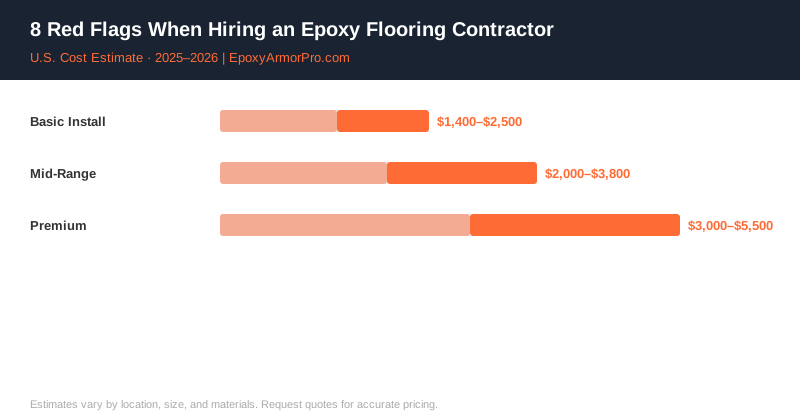
Here’s a number to know: professional epoxy installation — using commercial-grade 100% solids epoxy with proper surface prep — costs between $3 and $7 per square foot for most garage floors. Decorative or polyaspartic systems run higher.
If someone is quoting $1.00 to $1.50 per square foot, one of three things is happening:
- They’re using a water-based big-box kit and charging professional prices for DIY materials
- They’re skipping surface prep (or doing it improperly)
- They’ll find a way to add charges after the work starts
According to a 2023 survey by the National Floor Safety Institute, coating failures attributed to inadequate surface preparation account for over 70% of flooring warranty claims. Cheap quotes almost always mean cheap prep.
Red Flag #3: No Discussion of Surface Preparation
Ask any legitimate epoxy contractor what their prep process is and they’ll talk for five minutes about diamond grinding profiles, CSP (concrete surface profile) ratings, crack repair, and moisture testing. They care about prep because they know it determines whether the job succeeds or fails.
A contractor who glosses over prep — or says they’ll “clean and etch” the surface — is telling you exactly what kind of job you’re going to get. Acid etching is cheaper and faster than mechanical grinding. It’s also dramatically less effective at opening the concrete surface for proper epoxy adhesion.
Acid-etched floors often look fine for 6 to 18 months. Then they peel. And when they do, you’re paying full price again to strip the floor and do it right.
Red Flag #4: No Written Contract (or a Vague One)
Verbal agreements aren’t contracts. If a contractor hands you a one-page quote with nothing but a total price and asks you to sign, walk away. A proper epoxy flooring contract should specify:
- The square footage being coated
- The specific product (manufacturer, product name, solids content)
- The prep method
- Number of coats and thickness in mils
- Timeline and cure schedule
- Payment milestones (not 100% upfront)
- Warranty terms in writing
Anything less than this puts you at a disadvantage if the job goes sideways. For a complete breakdown, see our epoxy contract checklist.
Red Flag #5: High-Pressure Sales Tactics
“This price is only good today.” “I have another job in your neighborhood and I can give you a deal if we start this week.” “Someone else is interested in this slot.”
These are scripted pressure tactics. Legitimate contractors don’t need to manufacture urgency. They have full schedules because they do good work and get referrals. When a contractor pressures you to decide immediately, they’re betting that you won’t take time to get other quotes — because if you did, you’d realize theirs isn’t competitive on quality or price.
Take the time. Get three quotes. Anyone who won’t wait 48 hours for your decision isn’t someone you want on your property.
Red Flag #6: No Proof of Insurance
Ask for a certificate of insurance showing general liability (at minimum $1 million per occurrence) and workers’ compensation. This is a standard request. Established contractors send these out dozens of times a year.
If they hesitate, make excuses, or offer to “send it later,” that’s your answer. Work done by an uninsured contractor on your property creates liability exposure for you if someone is injured. It also leaves you with no recourse if they damage your property and disappear.
| Red Flag | What It Usually Means |
|---|---|
| Phone quote without site visit | Guessing or planning to cut corners |
| Under $2.00/sq ft installed | Cheap materials or skipped prep |
| No prep discussion | Acid etch instead of grinding |
| Vague or verbal contract | No accountability if things go wrong |
| Pressure to decide today | Hiding from comparison shopping |
| No insurance certificate | Uninsured — your liability exposure |
| Can’t name the product | Unlicensed or unqualified |
| 100% payment upfront | High fraud risk |
Red Flag #7: They Can’t Name the Product
“We use professional-grade epoxy” is not an answer. Push for specifics: What manufacturer? What product line? What’s the solids content? What’s the minimum recommended film thickness?
A trained applicator knows this information cold. It’s literally the product they use every day. If they can’t answer — or give you vague responses like “it’s a commercial formula we mix ourselves” — you don’t know what’s going on your floor. And you have no manufacturer warranty to fall back on if it fails.
Reputable contractors use products from manufacturers like Sherwin-Williams, BASF, Tennant, or similar commercial lines. They can name the product without hesitating.
Red Flag #8: They Ask for Full Payment Upfront
A deposit is normal — typically 25–40% to cover materials. But any contractor asking for 100% payment before work begins is either in financial trouble or planning to leave you with an unfinished job.
The BBB receives hundreds of complaints annually about flooring contractors who collect full payment and then disappear, delay indefinitely, or do shoddy work knowing they’re already paid. Pay a deposit. Pay progress milestones. Pay the final balance after you’ve walked the floor and signed off.
What Good Looks Like
The right contractor shows up, measures your floor, asks about your use case (vehicle parking vs. workshop vs. home gym), checks for moisture, discusses prep method specifically, hands you a detailed written proposal, and follows up without pressuring you.
They’re busy. They don’t need to manufacture urgency. They carry insurance as a matter of course. And they’re happy to give you references from recent jobs.
That contractor exists in your market. Use the time you’d spend chasing low-ball quotes to find them instead.
Contractor Referral Disclaimer: EpoxyArmorPro is a contractor referral and cost information service, not a licensed flooring contractor. We connect consumers with independent, licensed, and insured contractors. We do not perform any flooring work directly. Cost estimates are averages based on market data and vary by location, project size, materials, and contractor. Always verify contractor licensing and insurance before hiring. Individual quotes may differ from estimates shown.