You email three contractors, give them rough square footage, and ask for a ballpark. Two respond with numbers. You pick the lower one. The job comes out mediocre, the floor starts peeling in 18 months, and you can’t figure out what went wrong.
This is the most common epoxy flooring story homeowners tell us — and it almost always starts with the quoting process. A quote based on incomplete information isn’t a quote. It’s a guess, and you’re the one who absorbs the difference when the guess is wrong.
Here’s how to approach the quote process so you actually get accurate, comparable numbers.
Before You Contact Anyone: Prepare Your Project Information
The more specific you can be upfront, the more accurate the quotes you’ll receive. Before reaching out to a single contractor, gather:
Square footage: Measure the actual area to be coated. Length times width gets you most of it — but also note any insets, alcoves, or areas around columns. If you have a 2-car garage, you’re likely looking at 400–600 square feet depending on the layout.
Current floor condition: Take honest stock of what you’re working with. Cracks? Spalling? Oil stains? A previous coating that’s failing? Each of these affects prep requirements and therefore cost. Photograph the problem areas before anyone shows up.
Previous coatings: If there’s any existing paint, sealer, or old epoxy on the floor, say so explicitly. Removing prior coatings is a significant prep step that changes the scope and cost of the job.
Intended use: A floor that’ll hold two daily-driver vehicles, a motorcycle, and a workshop has different requirements than a floor that’s mostly decorative. High-traffic, high-chemical-exposure applications benefit from thicker systems and UV-stable topcoats.
Your timeline: When do you need it done? If you have a hard deadline — a move, a sale, an event — say so upfront. It affects scheduling and may affect pricing.
Set Up the Quote the Right Way
Don’t request quotes over email with just square footage. Get the contractor on-site or on a video call where they can actually look at the floor.
An in-person assessment lets the contractor:
- Confirm actual measurements (often different from homeowner estimates)
- Spot moisture issues, structural cracks, or contamination that changes the scope
- Recommend the right system for your specific use case
- Give you a quote that will actually hold when the work starts
According to HomeAdvisor’s 2024 consumer data, projects where the contractor did an in-person assessment before quoting had a 23% lower rate of final invoice disputes compared to projects quoted remotely. That’s a significant difference that costs you nothing but 30 minutes of your time.
What an Accurate Quote Includes
A real epoxy flooring quote isn’t a number on a napkin. It should break down:
| Quote Component | What to Look For |
|---|---|
| Square footage | Actual measured area, not estimated |
| Materials | Named product, solids content, number of coats |
| Prep scope | Method, crack repairs included or excluded |
| Labor | Separately itemized from materials |
| Flakes/decorative elements | Described by type and broadcast rate |
| Cleanup/disposal | Who handles diamond grinding dust and waste |
| Timeline | Start date, estimated completion |
| Warranty terms | Duration, what’s covered |
| Payment schedule | Deposit and final payment amounts |
| Total | All-in, not subject to change without written change order |
If a quote is missing several of these elements, ask for them to be added. A contractor who won’t detail what they’re installing and how they’re preparing the surface is a contractor who’s leaving themselves room to cut corners.
Why the Lowest Bid Usually Costs More
It feels backwards, but it’s consistently true: in epoxy flooring, the cheapest quote is almost always the most expensive outcome.
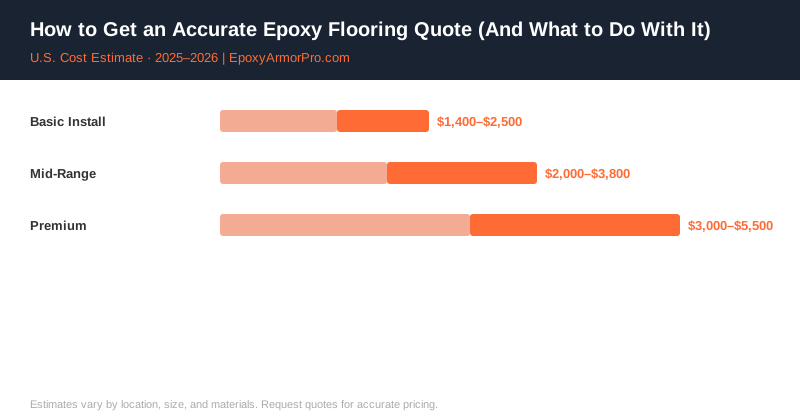
Here’s why. Professional epoxy installation — 100% solids commercial materials, diamond grinding prep, three-coat system — costs between $3 and $7 per square foot installed in most US markets. When a quote comes in at $1.50 to $2.00 per square foot, the contractor is either:
- Using water-based big-box materials (dramatically shorter lifespan, peeling risk)
- Skipping diamond grinding in favor of acid etching (adhesion failure within 12–24 months)
- Applying fewer coats or thin coats (wear-through faster, less chemical resistance)
- Planning to add charges once work has started
A floor that peels in 18 months costs you the original quote again to strip and redo correctly. The “cheap” quote is actually two full quotes out of pocket over two years.
A 2023 industry survey by the National Floor Safety Institute found that over 70% of coating warranty claims were attributed to inadequate surface preparation — the exact corner that low-bid contractors are most likely to cut.
How to Compare Quotes That Aren’t Apples-to-Apples
Three quotes that look different aren’t necessarily comparable — they might be for different systems. Before comparing prices, verify:
Same prep method: Diamond grinding or shot blast vs. acid etch are genuinely different products. The acid-etched quote will always be cheaper. But you’re comparing a 15-year floor to a 2-year floor.
Same materials spec: 100% solids epoxy vs. 70% solids vs. water-based are different durability tiers. Ask each contractor for the product name and solids content. If they’re specifying different products, you need to account for that difference in durability expectations.
Same coat count: A primer + color coat + clear topcoat is meaningfully different from two coats of color epoxy with no topcoat. Ask specifically.
Crack and damage treatment: One quote may include crack repair; another may not. Find out what each contractor does with existing damage.
Once you’ve confirmed the scope is equivalent, then price comparison is meaningful. If the scopes differ, you need to either ask for a revised quote matching your preferred spec or factor the differences into your decision.
Negotiating the Quote
Legitimate contractors have real cost floors based on materials and labor. Aggressive bargaining on price usually results in corner-cutting rather than genuine savings.
What you can legitimately negotiate:
- Timeline flexibility: If you’re not in a rush, contractors may discount slightly for scheduling flexibility
- Scope adjustments: Choosing a two-coat system instead of three, or skipping flakes to reduce cost
- Payment timing: Some contractors offer a small discount for early payment of the final balance
- Referral agreements: “If I give you two referrals, is there a discount?” Some contractors respond positively
What to avoid: pushing price below the point where quality is possible. If you’ve beaten a contractor down to $2/sq ft and the market rate for good work is $4/sq ft, someone is absorbing that $2 difference — and it’s probably your floor’s lifespan.
For a full breakdown of what affects epoxy flooring costs, see our garage epoxy cost factors guide and our overview of whether epoxy flooring is worth the investment.
Contractor Referral Disclaimer: EpoxyArmorPro is a contractor referral and cost information service, not a licensed flooring contractor. We connect consumers with independent, licensed, and insured contractors. We do not perform any flooring work directly. Cost estimates are averages based on market data and vary by location, project size, materials, and contractor. Always verify contractor licensing and insurance before hiring. Individual quotes may differ from estimates shown.