Last February, a homeowner in Rochester, Minnesota called three epoxy contractors. Two refused to schedule until April. The third quoted a rush job. He took the rush job, and by May his new floor was delaminating in sheets. The lesson isn’t that cold-climate epoxy is impossible — it’s that it demands a completely different approach than a Phoenix or Atlanta install.
If you’re in Minnesota, Wisconsin, Montana, upstate New York, or anywhere that sees real winters, here’s what changes and what you need to ask for.
Why Cold Climates Are Hard on Epoxy (and Bare Concrete)
NOAA data puts Minneapolis at an average of 156 freeze-thaw cycles per year — days where temperatures cross the 32°F threshold at least once. Each cycle forces moisture inside concrete pores to expand by roughly 9% as it freezes, then contract as it thaws. Over years, that mechanical stress fractures concrete from the inside out, producing the characteristic spalling, pitting, and surface pop-outs that northern garages are famous for.
Bare concrete handles this badly. Sealed concrete — properly coated with a quality epoxy or polyaspartic system — handles it dramatically better, because the coating blocks water infiltration at the surface before it ever reaches those pores. The coating IS the freeze-thaw defense system.
But here’s the problem: applying epoxy in cold weather requires careful attention to temperatures during installation, or the coating itself can fail catastrophically.
The 50°F Rule — and Why It Matters
Standard epoxy coatings require a minimum ambient and substrate temperature of 50°F at application and during initial cure. Below that threshold:
- The epoxy’s chemical reaction slows or stalls, leaving a soft, tacky film that never fully hardens
- Adhesion to the concrete surface drops sharply
- The coating becomes far more susceptible to moisture contamination from condensation
- You risk a complete delamination failure — sometimes within weeks
This isn’t a rough guideline. Most manufacturers specify it in their technical data sheets, and professional contractors know it cold (no pun intended). If someone offers to coat your garage floor in January without heating the space first, walk away.
| Scenario | Risk Level | Notes |
|---|---|---|
| Substrate temp below 50°F | Very High | Coating won’t cure properly |
| Substrate temp 50–60°F | Moderate | Extended cure time needed |
| Substrate temp 60–75°F | Low | Ideal range |
| Dew point within 5°F of surface temp | High | Condensation risk, adhesion failure |
Road Salt and De-Icer Damage: A Separate Problem
Freeze-thaw cycling is one enemy. Road salt is another — and it’s arguably worse in terms of long-term concrete damage.
Sodium chloride (standard road salt) and calcium chloride (used in colder states because it works below 15°F) both accelerate concrete deterioration through a chemical process called freeze-thaw scaling. The salt lowers the freezing point of the water it’s dissolved in, causing more freeze-thaw cycles to occur within the concrete structure than would happen with plain water. Calcium chloride is especially aggressive — research published in the journal Cement and Concrete Research has documented significantly accelerated surface scaling when calcium chloride concentrations exceed 3% in concrete pore water.
Your car tracks this stuff directly onto your garage floor every winter. If the concrete is bare, it’s absorbing concentrated brine every time you pull in.
A properly installed epoxy system with a polyaspartic topcoat creates a near-impermeable barrier that prevents this brine from reaching the concrete. Maintenance is simple: rinse the floor when salt accumulates, ideally before it dries.
Polyaspartic: The Cold-Climate Advantage
Standard epoxy has that 50°F minimum. Polyaspartic coatings — a newer chemistry used primarily as topcoats, though some contractors now use full polyaspartic systems — can be applied at temperatures down to 25°F in some formulations.
That’s a meaningful operational difference in Minnesota or Wisconsin, where fall and spring windows are short and unpredictable. A polyaspartic system can be installed in October or early April when epoxy would be marginal. It also cures faster (often in 2–4 hours vs. 24 hours for standard epoxy), which matters when you can’t leave the garage heated and open for a full day.
For a full breakdown of the chemistry and cost tradeoffs, see our Epoxy vs. Polyaspartic guide.
- Confirm substrate temp is at least 50°F before any coating starts (use an infrared thermometer)
- Space must be heated to maintain temp during full cure period (typically 24–72 hours)
- Check dew point — surface temp must be at least 5°F above the dew point
- Ask your contractor about polyaspartic options for fall/spring installs
- Repair all existing spalling and cracks before coating — don’t seal in damaged concrete
Timing Your Install in Northern States
Realistically, the safe window for epoxy installation in northern climates runs from late May through mid-September, assuming you’re not actively heating the space. That’s the window when unheated garages reliably stay above 50°F through the cure period.
Spring and fall can work if:
- The garage is insulated and can be heated to 60°F+ reliably
- You use a polyaspartic system rated for lower temps
- The contractor monitors temperature throughout the cure period
Winter installs are possible but require portable heating, careful humidity management, and a contractor who genuinely knows what they’re doing. Expect to pay a premium — and verify references from previous cold-weather jobs specifically.
What to Expect to Pay in Cold-Climate States
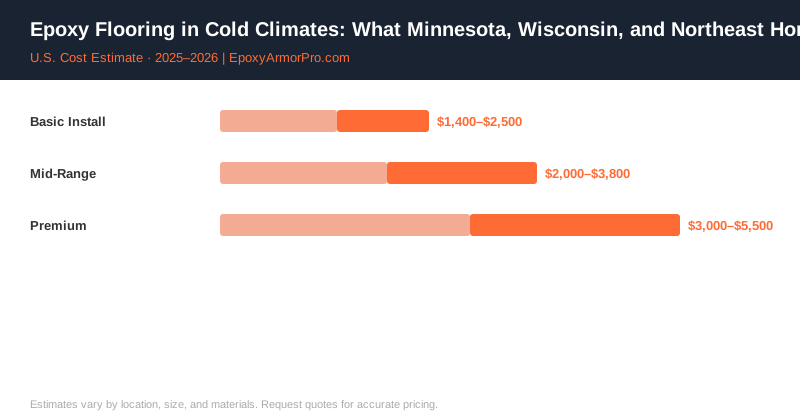
Cold-climate installs often run slightly higher than national averages due to the additional prep work (repairing freeze-thaw damaged concrete) and the shorter installation windows (higher contractor demand in spring).
| Service | National Average | Cold-Climate Premium |
|---|---|---|
| 2-car garage epoxy (400 sq ft) | $1,200–$2,400 | +10–20% for crack repair |
| Polyaspartic upgrade | +$0.50–$1.50/sq ft | Standard pricing |
| Crack/spalling repair | $2–$8/linear ft | Often needed in northern states |
| Surface grinding/prep | $0.75–$1.50/sq ft | Required for scaled concrete |
For more detail on what drives epoxy costs, see our garage epoxy flooring guide.
The Bottom Line
Cold climates don’t make epoxy a bad investment — they make it a more important one. A quality coating protects concrete from the freeze-thaw and salt damage that’s quietly destroying unprotected northern garage floors every winter. But installation has real temperature constraints that matter, and hiring a contractor who understands cold-climate chemistry is non-negotiable.
Don’t let anyone cut corners on temp or surface prep. The $200 you save on a rushed spring job can cost you $2,000 in a failed floor two years later.
Contractor Referral Disclaimer: EpoxyArmorPro is a contractor referral and cost information service, not a licensed flooring contractor. We connect consumers with independent, licensed, and insured contractors. We do not perform any flooring work directly. Cost estimates are averages based on market data and vary by location, project size, materials, and contractor. Always verify contractor licensing and insurance before hiring. Individual quotes may differ from estimates shown.