Three miles from the ocean, your garage floor faces chemistry that an inland home never sees. Salt air — sodium chloride aerosol carried inland from breaking waves — settles on every exposed surface. On bare concrete, it’s a slow-motion attack. The chloride ions penetrate the concrete matrix, react with calcium silicate hydrate (the compound that gives concrete its strength), and accelerate surface scaling. NOAA atmospheric studies estimate that airborne chloride deposition rates within one mile of the ocean can be 10 to 50 times higher than at sites just 5 miles inland.
That context matters when you’re deciding whether to leave your garage floor bare or coat it.
What Salt Air Actually Does to Concrete
The corrosion mechanism isn’t dramatic — it’s gradual. Chloride ions from salt air dissolve in surface moisture (condensation, rain, tracked-in seawater) and migrate into the concrete’s pore structure. There, they disrupt the passive layer protecting any steel reinforcement and accelerate concrete surface degradation through a chemical process called chloride-induced corrosion.
For an unreinforced garage slab, the main visible result is surface scaling and pitting — the rough, chalky, increasingly uneven surface you see on coastal garage floors that haven’t been coated. Over 10–20 years, this isn’t cosmetic. It’s structural: the concrete loses compressive strength at the surface, creating a crumbling layer that eventually needs grinding or full replacement.
A quality epoxy or polyaspartic coating creates a near-impermeable barrier that stops chloride infiltration before it starts. This is why coastal maintenance departments and marina operators have been coating concrete with epoxy for decades — the corrosion protection is real and documented.
Marine-Grade vs. Standard Residential Epoxy
“Marine-grade” epoxy is a term you’ll hear from some coastal contractors. What it actually means varies, but the key differentiators for coastal application are:
Chemical resistance: Marine-grade epoxy systems use 100% solids formulations (no water-based products, which have lower film integrity) with higher resistance to chloride ion penetration.
UV stability: Coastal environments get intense UV exposure, especially in Florida, California, and the Gulf Coast. Standard aromatic epoxy yellows rapidly under UV. A UV-stable aliphatic polyaspartic topcoat is essential for any coastal floor that sees sunlight. See our UV-resistant epoxy guide for the chemistry details.
Film thickness: Coastal applications typically call for a thicker total system — a base primer, a 100% solids epoxy base coat, and a UV-stable clear topcoat — rather than a single-coat residential system. Total dry film thickness of 20–40 mils is common in coastal commercial applications vs. 10–15 mils for standard residential installs.
Moisture tolerance: Coastal concrete often has elevated moisture vapor transmission due to proximity to the water table (especially in Florida and low-lying coastal areas). A moisture-tolerant primer is standard for serious coastal installs.
| System Component | Standard Residential | Coastal/Marine Upgrade |
|---|---|---|
| Primer | Water-based epoxy primer | 100% solids moisture-tolerant primer |
| Base coat | Water-based or 100% solids epoxy | 100% solids epoxy, thicker mil spec |
| Topcoat | Optional polyaspartic clear | UV-stable aliphatic polyaspartic (required) |
| Film thickness | 10–15 mils total | 20–40 mils total |
| Salt resistance | Moderate | High — designed for chloride environments |
Hurricane and Flood Preparation
Coastal homeowners in Florida, the Gulf Coast, and the Carolinas face the additional reality of storm surge and flooding. Epoxy floors handle standing water well — they’re waterproof — but flooding creates some specific concerns:
Hydrostatic pressure from below: In a major flood event, water-saturated soil creates upward pressure on the slab. If hydrostatic pressure exceeds the bond strength of the epoxy, the coating can pop up in sheets — not because the epoxy failed chemically, but because it’s being pushed up from underneath. This is the same phenomenon that causes pool liners to pop up when groundwater rises faster than the pool can equalize.
For high-flood-risk zones (Florida, coastal Louisiana, Texas coastal plain), discuss this risk with your contractor. Some installers use a vented or “breathable” epoxy system in flood zones that allows vapor transmission while still resisting surface water — essentially letting the coating breathe rather than trapping hydrostatic pressure.
Debris abrasion: Storm surge carries sand, shell, and debris that can scratch and scuff any floor coating. This is primarily a topcoat durability issue; a hard polyaspartic topcoat handles abrasion significantly better than a standard epoxy clear coat.
Post-flood cleanup: Epoxy floors clean up after flooding far more easily than bare concrete. Mold, sediment, and contaminated floodwater don’t penetrate the coating and can be cleaned with standard disinfectants. Bare concrete absorbs contaminated water into its pore structure, creating persistent mold problems.
Sand Tracking: The Daily Reality of Beach Homes
If you live near the beach, you track sand. Sand is abrasive — effectively a fine-grit sandpaper that’s constantly being walked across your floor. For any floor coating, this means accelerated wear on the topcoat.
Practical solutions:
- Broadcast silica sand into the topcoat during application: This creates a textured surface that’s actually more resistant to abrasion than a smooth coat, and adds slip resistance when wet. Many coastal contractors do this as standard practice.
- Use a harder polyaspartic topcoat: Polyaspartic topcoats have a higher Shore D hardness rating than standard epoxy, meaning they resist scratching better over time.
- Entry mats at the garage-to-house transition: Simple, but effective at capturing the worst of the sand before it reaches the main floor area.
- Regular damp mopping: Sand that sits and gets walked on does more damage than sand that gets swept or rinsed away. A weekly mop goes a long way.
- Specify 100% solids epoxy (no water-based products)
- Require moisture-tolerant primer for any coastal or near-water-table slab
- Require UV-stable aliphatic topcoat — non-negotiable in Florida, Gulf Coast, Southern California
- Ask about film thickness spec — push for 20+ mils total for coastal applications
- Discuss anti-slip aggregate broadcast into topcoat (especially for beach homes)
- If in a flood zone, ask about vented systems or hydrostatic pressure mitigation
Coastal Pricing: What to Budget
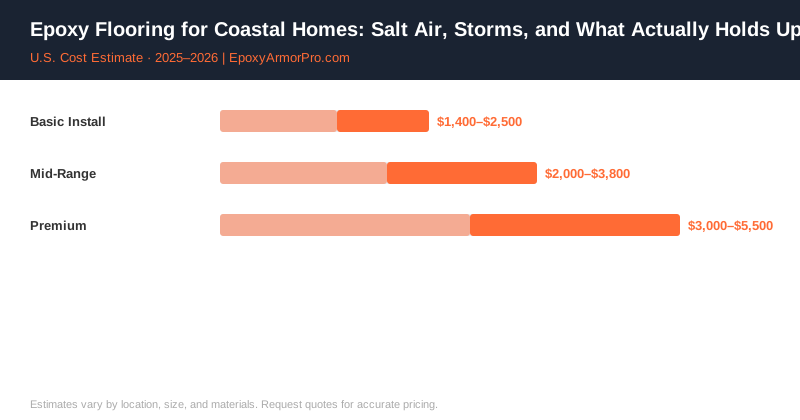
Coastal installs run higher than national averages due to the upgraded product specs and additional prep often required.
| Service | National Average | Coastal Premium |
|---|---|---|
| 2-car garage epoxy system | $1,200–$2,400 | +15–30% for marine-grade spec |
| UV-stable polyaspartic topcoat | +$200–$600 | Standard for coastal — not optional |
| Moisture-tolerant primer | +$150–$350 | Standard for coastal Florida/Gulf |
| Anti-slip broadcast aggregate | +$100–$250 | Recommended for beach homes |
| Surface grinding (scaled concrete) | $0.75–$1.50/sq ft | Common on older coastal slabs |
For general cost context, see the garage epoxy flooring guide.
The Right Contractor Matters More at the Coast
An inland contractor unfamiliar with coastal conditions may use water-based products, skip the moisture primer, and apply a standard epoxy clear instead of a UV-stable topcoat. That floor will look fine on day one. In 18–24 months, you’ll start seeing yellowing, then blistering, then lifting edges.
Ask any contractor you’re interviewing whether they’ve done coastal installs specifically, what primer system they use on slabs near the water table, and what their topcoat specs are for UV resistance. If they don’t have specific answers, keep looking.
Contractor Referral Disclaimer: EpoxyArmorPro is a contractor referral and cost information service, not a licensed flooring contractor. We connect consumers with independent, licensed, and insured contractors. We do not perform any flooring work directly. Cost estimates are averages based on market data and vary by location, project size, materials, and contractor. Always verify contractor licensing and insurance before hiring. Individual quotes may differ from estimates shown.