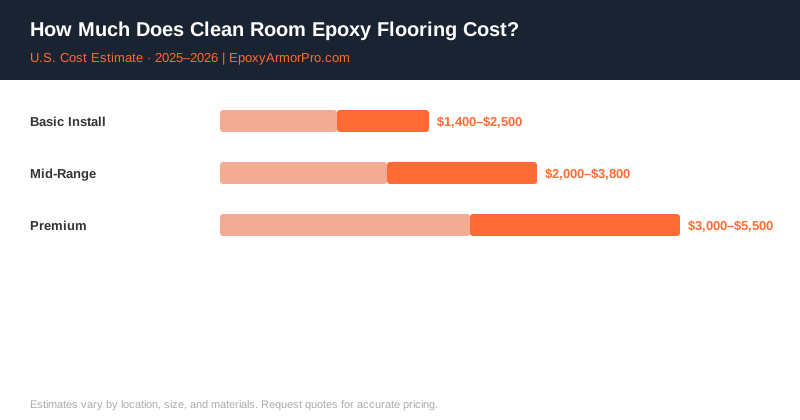
What makes a floor “clean room grade,” and does it really cost three times more than a regular epoxy job? Yes — and the reason isn’t marketing. It’s particulate control, static dissipation, and a level of seamlessness that standard commercial epoxy was never designed to deliver.
What ISO Classification Does to the Price
Clean rooms are classified under ISO 14644-1, ranging from ISO 1 (the strictest, essentially particle-free) to ISO 9 (roughly equivalent to normal indoor air). The flooring spec tightens as the classification number drops. An ISO 8 clean room (light electronics assembly, some medical device packaging) can often use a well-installed standard epoxy system. An ISO 5 or lower clean room (semiconductor fabrication, sterile pharmaceutical compounding) demands a fully seamless, static-dissipative or conductive system with cove base integration at every wall-floor junction.
| Clean Room Class | System Type | Cost per Sq Ft |
|---|---|---|
| ISO 8–9 (light assembly) | Standard seamless epoxy | $8–$14 |
| ISO 6–7 (electronics, packaging) | Static-dissipative epoxy | $12–$20 |
| ISO 5 or lower (pharma, semiconductor) | Conductive/ESD epoxy with integral cove base | $18–$28 |
| Integral cove base (per linear ft) | Add-on, all classes | $15–$30 |
| Antimicrobial additive | Add-on | +$1–$3 per sq ft |
A 2,000-square-foot ISO 7 clean room typically runs $24,000–$40,000 fully installed, including cove base and joint sealing — a figure that surprises facility managers pricing against a warehouse floor quote.
Static Control Is Non-Negotiable in Electronics and Pharma
Electronics manufacturing and many pharmaceutical processes require static-dissipative or fully conductive flooring to prevent electrostatic discharge (ESD) from damaging sensitive components or igniting solvent vapors. These systems use conductive additives — carbon fiber or metallic particles — blended into the epoxy resin, and they require grounding straps tied into the building’s electrical grounding system. ASTM F150 is the standard test method used to verify a floor’s electrical resistance falls within the required range.
Surface Prep Standards Are Stricter Too
The International Concrete Repair Institute’s surface profile guidance (ICRI 310.2) still applies, but clean room jobs typically call for a more consistent, finer profile than an industrial floor — the goal is a surface that bonds well without creating texture that traps particulates. Contractors often combine diamond grinding with vacuum-shrouded tooling to control dust during prep, since airborne concrete dust can contaminate adjacent clean areas during construction.
Questions for Your Contractor
- Have you installed flooring certified to the specific ISO class we need?
- Is the cove base integral (poured/formed) or a separate cap strip?
- What’s the system’s electrical resistance, tested per ASTM F150, if ESD control is required?
- How do you control dust during grinding to protect adjacent clean areas?
- What’s the recommended cure time before ISO particle-count commissioning?
Pharmaceutical and food-grade facilities share some of these same requirements — see our pharmaceutical facility flooring guide for the compliance side of the spec.
Contractor Referral Disclaimer: EpoxyArmorPro is a contractor referral and cost information service, not a licensed flooring contractor. We connect consumers with independent, licensed, and insured contractors. We do not perform any flooring work directly. Cost estimates are averages based on market data and vary by location, project size, materials, and contractor. Always verify contractor licensing and insurance before hiring. Individual quotes may differ from estimates shown.