Most failed epoxy floors weren’t installed with bad products. They were installed by contractors who skipped prep steps, used the wrong primer, misread the moisture level, or rushed the cure. You can’t see any of that until the floor starts peeling — usually 12–18 months after the check cleared.
The Concrete Coating Association estimates that 80% of coating failures are attributable to inadequate surface preparation rather than product defects. That number puts the responsibility squarely on the contractor you hire, not the epoxy brand on the bucket.
This checklist is how you separate contractors who know what they’re doing from the ones who don’t — before it costs you a floor.
Before the Quote
1. Check Their License and Insurance
This sounds basic, but a large percentage of one-truck coating operations are operating without a valid contractor’s license or liability insurance. In most states, flooring contractors need a license — and the requirements vary. At minimum, confirm:
- General liability insurance: $1M per occurrence minimum. Ask for the certificate and verify the policy is current.
- Workers’ compensation: If they have employees, they need it. Injured workers on your property without coverage become your liability.
- State contractor’s license: Check your state’s licensing board online. Takes 2 minutes.
2. Ask for 3–5 Recent References, Not Testimonials
Testimonials on a website are curated. Real references — names, phone numbers, project addresses — are verifiable. Ask specifically for garages or commercial spaces similar to yours, completed within the last 2 years. Call them. Ask one question: “Is the floor still in perfect condition?”
3. Look at Photos of Their Actual Work (Not Stock Images)
Request photos from their last 5 completed projects. A contractor proud of their work has hundreds of job-site photos on their phone. If they can’t produce recent photos of completed floors, that’s a meaningful signal.
The Prep Method Questions (Most Important Section)
4. “How Do You Profile the Concrete Surface?”
The correct answer, per the International Concrete Repair Institute (ICRI) and the Concrete Coating Association: diamond grinding to achieve a Concrete Surface Profile (CSP) of 2–3. This creates the mechanical tooth that lets epoxy bond at the level required for long-term adhesion.
Wrong answers that should end the conversation:
- “We acid etch and pressure wash” — adequate only for light-duty water-based coatings, not vehicle traffic
- “We sweep and clean it” — this is not surface prep
- “The product we use doesn’t require profiling” — no 2-part epoxy primer eliminates the need for mechanical profiling
A contractor using a shot blaster is also acceptable (CSP 3–4) for industrial applications, though grinding is standard for residential garages.
5. “Do You Test for Moisture Vapor Emission?”
Concrete breathes moisture from the ground up. High moisture vapor emission rate (MVER) causes epoxy delamination from beneath. A contractor who doesn’t test doesn’t know whether the system they’re installing is appropriate for the slab.
The industry standard test is ASTM F1869 (calcium chloride test) or ASTM F2170 (in-situ relative humidity probe). Testing takes 24–72 hours but is mandatory for any professional specification.
If the MVER is above the product’s limit, a moisture-tolerant primer or moisture-vapor barrier is required. A contractor who skips testing and installs standard epoxy over a high-MVER slab is handing you a warranty claim waiting to happen.
6. “How Do You Handle Existing Cracks and Control Joints?”
Active cracks (still moving) need polyurethane joint filler before coating — epoxy bridges the crack but won’t hold if the concrete continues to move. Dormant hairline cracks can be filled with rigid epoxy filler. Control joints should be honored — filled flush, not bridged, so the joint can continue functioning.
A contractor who just coats over open cracks without addressing them is installing a floor that will show those cracks through the topcoat within months.
The Product Questions
7. “What’s the Solids Content of Your Epoxy?”
Professional 100% solids epoxy is the standard for vehicle-traffic garages. 40–60% solids products lose thickness during cure and produce thin, less durable films. Ask for the product data sheet (PDS) and confirm the volume solids percentage.
If they can’t or won’t show you the PDS, that’s a problem.
8. “What Is the Total Dry Film Thickness of the Complete System?”
This is the spec that determines how long the floor lasts. A properly specified residential garage system should achieve 10–16 mils DFT from primer through topcoat. For context, see our epoxy system thickness guide — it explains exactly what each mil level means for durability.
Get this number in writing on the contract.
9. “What Topcoat Are You Using?”
The topcoat determines UV stability, hot tire resistance, chemical resistance, and surface gloss. The main options:
- Aliphatic polyurethane: Excellent UV stability, good chemical resistance, standard choice for residential garages
- Polyaspartic: Fast cure, excellent UV stability, hot tire resistance, more expensive
- Standard epoxy clear: Prone to UV yellowing, not recommended as a topcoat in sun-exposed areas
If the contractor plans to topcoat with the same epoxy product used for the color coat — rather than a dedicated topcoat product — that’s a lower-quality specification.
Ask for the following documents from your contractor and verify each:
- Primer product data sheet — confirm moisture tolerance rating
- Base coat product data sheet — confirm volume solids %
- Topcoat product data sheet — confirm UV stability, hot tire resistance, and chemical resistance ratings
- Safety Data Sheets (SDS) for each product if you have pets or children and want to verify VOC levels
Any reputable contractor keeps these in their truck. Reluctance to share them is a red flag.
The Contract and Payment Questions
10. “What’s Your Warranty, and What Does It Cover?”
A warranty is only as good as the contractor’s ability to honor it. Get it in writing. Specifically ask:
- What’s the duration? (Professional residential: 5–15 years is reasonable; 1 year is not)
- What defects are covered? (Delamination, peeling, hot tire pickup, bubbling)
- What voids the warranty? (Many contractors exclude damage from “improper use” — get that defined)
- Is this the contractor’s warranty or the product manufacturer’s?
11. “What Percentage Do You Require Upfront?”
Industry standard is 0–30% deposit. Some contractors require 50%. More than 50% upfront is unusual and a potential red flag — it reduces your leverage if something goes wrong.
Never pay 100% before the job starts. Structure payments: deposit at contract signing, a second payment at substantial completion (coating down), final payment after your inspection and acceptance.
12. “What Is the Timeline — Days of Work and Days Before I Can Drive On It?”
Confirm both the installation timeline (how many days the crew is on-site) and the cure timeline (when you can resume normal use).
Standard professional timelines:
- Installation: 1–2 days for a residential garage
- Light foot traffic: 24 hours
- Vehicle traffic: 72 hours minimum; 7 days for full load-bearing cure
Contractors who tell you the car can go back in “tomorrow” after a polyaspartic topcoat might be correct — but verify it against the topcoat product data sheet’s cure specs.
The Red Flags Section
13. Do They Offer to Beat Any Price by 30%?
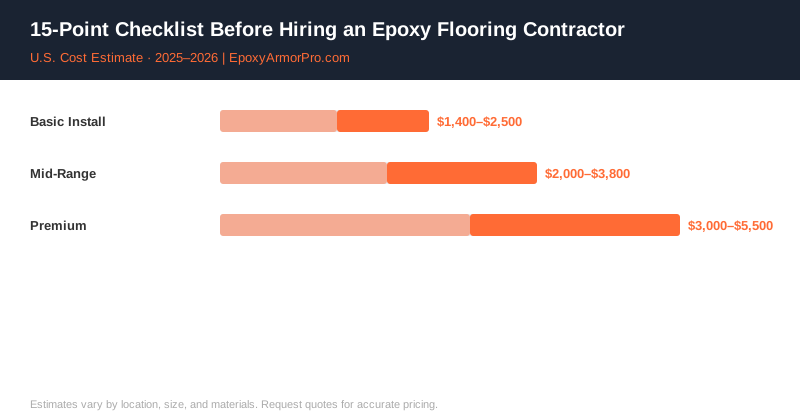
Price-match guarantees and dramatically low bids almost always mean something is being cut: surface prep time, product quality, or system thickness. The materials alone for a properly specified residential epoxy system run $0.75–$1.50/sq ft. Quotes below $1.50–$2.00/sq ft installed are almost always 40% solids water-based products applied over inadequate prep.
You’re not getting a deal. You’re getting a floor that looks great in photos and fails in 18 months.
14. Do They Apply Over the Existing Coating Without Removing It?
If there’s any existing coating on the concrete — paint, sealer, old epoxy — it must be mechanically removed before the new system goes down. Applying new epoxy over old coating is coating an unknown substrate. The new system is only as bonded as the old system below it.
Any contractor willing to coat over existing material without removing it isn’t doing the job correctly.
15. Is Everything You’ve Agreed to in Writing?
Verbal agreements about system thickness, products, prep method, timeline, and warranty don’t hold up when something goes wrong. The written contract should specify:
- Products to be used (brand and product name)
- Surface preparation method
- System thickness (DFT)
- Application temperature and humidity conditions
- Payment schedule
- Warranty terms
- What happens if moisture testing reveals a problem
If the contractor resists putting specifications in writing, that’s the clearest red flag of all.
For more guidance on contractor selection, see our article on how to find an epoxy flooring contractor and the red flags to watch for in contractor behavior.
Contractor Referral Disclaimer: EpoxyArmorPro is a contractor referral and cost information service, not a licensed flooring contractor. We connect consumers with independent, licensed, and insured contractors. We do not perform any flooring work directly. Cost estimates are averages based on market data and vary by location, project size, materials, and contractor. Always verify contractor licensing and insurance before hiring. Individual quotes may differ from estimates shown.