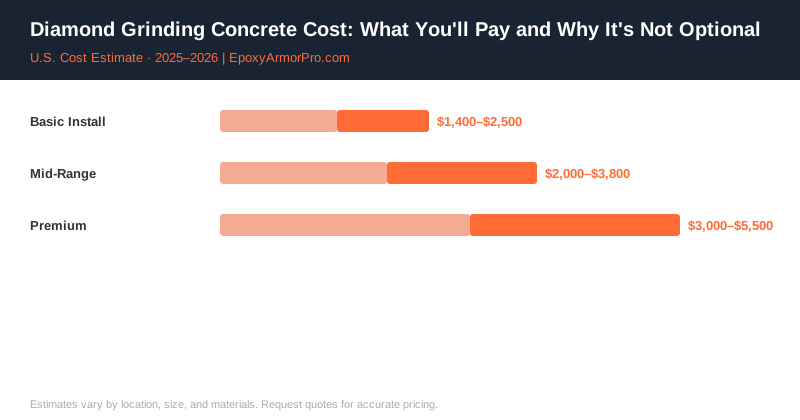
Your epoxy contractor quoted $800 just to prep the floor — before any coating. That’s not padding. That’s diamond grinding, and it’s the single most important step in the entire job.
Here’s what you’re actually paying for, what it costs to hire out versus rent, and why this isn’t a line item you can negotiate away.
What Diamond Grinding Actually Does
Diamond grinding uses rotating discs embedded with industrial-grade diamond segments to mechanically abrade the top layer of concrete. The result is a clean, open, slightly rough surface that epoxy can mechanically bond to.
The concrete flooring industry measures surface roughness using Concrete Surface Profile (CSP) ratings, defined by ICRI Technical Guideline No. 310.2R. The scale runs from CSP 1 (nearly smooth, like a polished countertop) to CSP 9 (extremely rough, like exposed aggregate). For most epoxy coating systems, the target is CSP 2–3 — a fine anchor pattern you can feel with your fingertip but wouldn’t notice visually.
Grind too light (CSP 1) and the epoxy won’t bond. Grind too aggressive (CSP 4+) and you waste coating filling the deep peaks and valleys. CSP 2–3 is the sweet spot.
Diamond grinding also removes:
- Surface laitance (the weak, dusty top layer that forms as concrete cures)
- Paint, old adhesive, and failed coating remnants
- Minor surface contamination from oils and chemicals
Nothing else does all three as reliably.
How Much Diamond Grinding Costs
Pricing depends on floor condition, total square footage, and whether you’re hiring a contractor or renting equipment.
| Scenario | Cost per Sq Ft | Notes |
|---|---|---|
| Contractor — clean, flat slab | $0.50–$0.90 | Standard residential prep |
| Contractor — painted or coated slab | $0.80–$1.50 | Extra passes to remove existing material |
| Contractor — rough, contaminated slab | $1.00–$2.00 | Heavy grind, possible multiple passes |
| Equipment rental (walk-behind grinder) | $150–$300/day | Plus diamond tooling: $40–$120 extra |
| Equipment rental (planetary grinder, larger) | $350–$600/day | Faster; better for 500+ sq ft |
For a typical two-car garage (about 450–500 sq ft), expect to pay $250–$900 for grinding when bundled into a full epoxy job. Standalone grinding — if you’re hiring someone just for prep — runs on the higher end of the per-sq-ft range since there’s no economy of scale with the full install.
Minimum charges are common. Most grinding contractors won’t mobilize for less than $300–$400 regardless of the floor size.
Rental vs. Hiring a Contractor
Renting a concrete grinder sounds like a smart cost-cutting move. Sometimes it is. Often it isn’t.
When rental makes sense:
- You have 200–300 sq ft or less
- The slab is in good condition with no old coatings to remove
- You’re physically capable of operating heavy equipment (walk-behind grinders weigh 150–300 lbs)
- You’ve done this before or are willing to learn
When to hire a contractor:
- Any floor over 400–500 sq ft (rental efficiency drops off fast)
- Floor has paint, epoxy, or adhesive that needs removal
- You want consistent CSP 2–3 across the whole slab — not just close
- Your time has value
According to the Concrete Polishing Association of America (CPAA), inconsistent surface profile is one of the leading causes of epoxy delamination on DIY and contractor jobs alike. Consistency across the whole slab matters as much as hitting the right average depth.
Why You Can’t Skip It — Or Use Acid Instead
Some contractors still offer acid etching as an alternative to grinding. It costs less. But ASTM F3191, the standard for field verification of concrete surface profile, notes that acid etching alone rarely achieves CSP 2 on densely cured or contaminated surfaces — and it can’t remove old coatings or embedded contamination at all.
The professional concrete coating industry shifted away from acid etching for anything beyond new, uncontaminated residential concrete over 15 years ago. Most coating manufacturers now void their product warranties if acid etching was used as the sole prep method on previously coated or contaminated floors. For a full comparison of both methods, see our acid etching vs. diamond grinding guide.
If an epoxy contractor quotes you a job with acid etching only and the floor has any previous coating or contamination history, push back — or get a second quote that includes grinding.
What the Grinding Prep Process Looks Like
A typical residential grind on a 500-sq-ft garage looks like this:
- Initial inspection — Contractor checks for oil stains, paint, cracks, high spots. Determines tooling and number of passes needed.
- Degreasing pass — Oil-contaminated areas get degreaser applied and scrubbed first. Grinding over oily concrete drives contamination deeper.
- Grinding passes — One to three passes depending on starting condition. Each pass opens more surface. Contractor checks CSP visually and by touch.
- Edge work — Walk-behind grinders can’t reach 2–3 inches from walls. Hand grinders with angle-grinder attachments handle the perimeter.
- Vacuum and clean — Industrial HEPA vacuum removes all concrete dust. This step matters — concrete dust sitting on a freshly ground surface is a bond barrier.
Total time: 2–4 hours for a 500-sq-ft garage in decent condition. Double that if there’s a previous coating to remove.
Asking the Right Questions Before You Hire
When getting quotes for epoxy installation, ask every contractor these specific questions:
- “Do you include diamond grinding in your prep process?”
- “What CSP target are you aiming for?”
- “How many passes will you do if there’s an old coating to remove?”
- “Will you do a moisture test before grinding or after?”
Any contractor who can’t answer the CSP question specifically, or who defaults to “we do acid etching” for a previously coated floor, is a risk. Proper prep costs money — and saves money on callbacks.
For a complete picture of what the full installation process involves after grinding, see our epoxy flooring installation guide and concrete prep guide.
Contractor Referral Disclaimer: EpoxyArmorPro is a contractor referral and cost information service, not a licensed flooring contractor. We connect consumers with independent, licensed, and insured contractors. We do not perform any flooring work directly. Cost estimates are averages based on market data and vary by location, project size, materials, and contractor. Always verify contractor licensing and insurance before hiring. Individual quotes may differ from estimates shown.