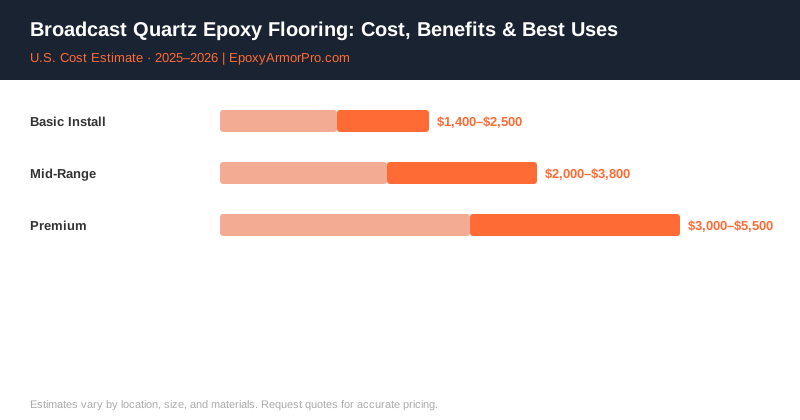
$7 per square foot installed — that’s the midpoint for a broadcast quartz epoxy system, and it’s money well spent in applications where standard flooring gets people hurt or wears out fast.
Quartz broadcast epoxy isn’t the flashy metallic floor you see on Instagram. It’s the floor under your feet at a hospital corridor, a commercial kitchen, a pool deck, or a university lab — and you probably didn’t notice it because it just works. That’s the point.
What “Broadcast Quartz” Actually Means
The process is straightforward. A base coat of epoxy goes down first, then colored quartz aggregate — angular grains about 20–30 mesh in size — gets broadcast (thrown by hand or machine) into the wet epoxy at a full-broadcast or partial-broadcast rate. A topcoat seals it all in place.
The result: a surface studded with hard, grippy mineral particles locked permanently into the floor. It’s not a coating that sits on top of concrete. It bonds to it.
The quartz aggregate is typically aluminum oxide or silica, both of which rate 7–9 on the Mohs hardness scale. That hardness translates directly to abrasion resistance — the American National Standards Institute rates slip resistance using the coefficient of friction (COF), and full-broadcast quartz systems regularly achieve a wet COF above 0.60, which exceeds the ADA’s minimum recommended 0.60 threshold for accessible routes.
Cost Breakdown for 2026
System spec and area size drive the price more than anything else.
| Application | Cost per Sq Ft (Installed) | Notes |
|---|---|---|
| Residential garage / patio | $5–$7 | Partial broadcast, single color |
| Commercial kitchen / food service | $7–$10 | Full broadcast, integral cove base |
| Pool deck / exterior | $6–$9 | Requires UV-stable polyaspartic topcoat |
| Hospital / lab corridor | $8–$12 | Anti-microbial additive, thicker system |
| Large warehouse (5,000+ sq ft) | $5–$8 | Economies of scale reduce labor cost |
Surface prep is not included in those numbers — it’s billed separately or rolled into the quote. If your concrete has existing coatings, oil saturation, or significant cracks, expect $1–$3 per square foot in additional prep charges before the quartz system even starts.
Quartz Broadcast vs. Vinyl Flakes: What’s the Actual Difference?
Most homeowners shopping for epoxy have seen decorative flake epoxy floors. The two systems look superficially similar — both broadcast particles into a wet base coat. The differences matter.
Hardness: Quartz aggregate is harder than vinyl flakes. Vinyl flakes can compress or degrade under heavy chemical exposure. Quartz won’t.
Slip resistance consistency: Vinyl flakes are flat, and their COF depends on topcoat texture. Quartz aggregate is angular — it bites into footwear the same way regardless of finish.
UV stability: Standard vinyl flakes hold color reasonably well, but they can fade over time in direct sun. Natural quartz aggregate doesn’t fade. The topcoat does the UV work — as long as you spec a UV-stable polyaspartic, quartz systems hold color outdoors for 10+ years.
Aesthetics: Flakes win here. The decorative variety in vinyl flakes is enormous — you can match virtually any color scheme. Quartz comes in natural stone tones: beige, gray, tan, charcoal. It looks clean and professional but not decorative.
Price: Flake systems run $3–$7 per square foot installed. Quartz broadcast systems run $5–$10. The premium reflects the material cost of quartz aggregate and the additional broadcast labor.
Best Applications for Quartz Broadcast Epoxy
This system earns its price in specific environments:
Pool decks and aquatic areas — The combination of wet conditions, bare feet, and ceramic tile alternatives that crack and chip makes quartz broadcast the go-to surface. The National Floor Safety Institute reports that over 8 million slip-and-fall injuries occur in the US each year — aquatic areas are a major contributor. A properly spec’d quartz floor removes most of that risk.
Commercial kitchens — Grease, water, thermal cycling from cooking equipment, and health department inspections all point to the same floor: seamless, slip-resistant, easy to clean. Full-broadcast quartz over a cementitious base coat handles all of it.
Exterior patios and walkways — With a UV-stable polyaspartic topcoat, quartz broadcast outlasts painted concrete, stamped concrete sealers, and tile in outdoor settings. It’s one of the few seamless systems that doesn’t deteriorate at expansion joints if properly installed.
Laboratory and cleanroom environments — The hard, non-porous surface resists chemical spills and can be formulated with anti-static additives for electronics labs.
How Quartz Broadcast Compares to Other Commercial Options
If you’re choosing between systems for a commercial or higher-end residential project, here’s where quartz broadcast sits in the landscape compared to other options covered on this site:
- Standard commercial epoxy: Less expensive at $3–$7/sq ft, fine for warehouses and light manufacturing, but lacks the defined slip-resistance profile of quartz.
- Polyaspartic-only systems: Faster cure (same-day return to service), but some polyaspartic systems don’t broadcast quartz as effectively as epoxy base coats. Often used as the topcoat over a quartz broadcast base.
- Polished concrete: No aggregate, smooth surface, lower slip resistance when wet. Not appropriate for wet work environments.
What to Ask Your Contractor
Before signing anything, get clear answers on these points:
- What’s the broadcast rate? Full or partial? What mesh size quartz?
- What topcoat are you using? Is it UV-stable? What’s the mil thickness?
- What’s included in surface prep? Is grinding and moisture testing part of the quote?
- What’s the cure time before foot traffic? Vehicle traffic?
- Do you provide a written warranty? What does it cover — adhesion only, or color and finish too?
A contractor who answers these without hesitation knows their product. One who deflects or gets vague deserves a follow-up call to someone else.
Quartz broadcast epoxy isn’t the cheapest option on the floor coating menu. It’s the one that earns its price on pool decks, in commercial kitchens, and anywhere that a slip or a coating failure has real consequences.
Contractor Referral Disclaimer: EpoxyArmorPro is a contractor referral and cost information service, not a licensed flooring contractor. We connect consumers with independent, licensed, and insured contractors. We do not perform any flooring work directly. Cost estimates are averages based on market data and vary by location, project size, materials, and contractor. Always verify contractor licensing and insurance before hiring. Individual quotes may differ from estimates shown.