The number on the label most homeowners never check is the one that explains everything. Two products can both say “epoxy” and deliver completely different results — one lasting two years before peeling, the other still performing at year fifteen. The difference is solids content.
What Solids Content Means
Every liquid coating contains two things: the actual coating material (the solids) and a carrier that keeps it workable and spreadable (water or solvent). When the coating cures, the carrier evaporates. The solids stay on the floor.
100% solids epoxy has no carrier. When you apply it, everything stays. Zero evaporates.
Water-based epoxy at 50% solids content means half of what you apply evaporates as water during curing. If you apply a 10-mil wet film, you end up with a 5-mil dry film.
This single difference drives the entire performance gap between the two categories.
The Thickness Math
Dry film thickness (DFT) is the critical metric for coating performance. More DFT means more impact resistance, more chemical barrier, more abrasion resistance, and longer service life before the floor needs maintenance.
Run the numbers on a single coat:
| Product | Solids Content | Wet Film Applied | Dry Film Result | Coverage (per gallon) |
|---|---|---|---|---|
| Consumer water-based epoxy | 40–50% | 10 mils | 4–5 mils | 250–300 sq ft |
| Pro water-based epoxy | 50–60% | 12 mils | 6–7 mils | 200–250 sq ft |
| Solvent-based epoxy | 60–70% | 12 mils | 7–8 mils | 200–250 sq ft |
| 100% solids epoxy | 100% | 10 mils | 10 mils | 160–200 sq ft |
The 100% solids product covers less square footage per gallon because nothing is evaporating off — every drop is coating. You’re paying for floor protection, not water.
Performance at Each Solids Level
The Concrete Coating Association’s testing data consistently shows a linear relationship between dry film thickness and coating longevity. Their research, published in industry guidelines for commercial and industrial floor coating specifications, shows coatings below 6 mils DFT demonstrate failure rates in high-traffic environments that are multiples higher than 10+ mil systems.
Water-based at 40–50% solids: Adequate for light-duty interior spaces with minimal vehicle traffic, chemicals, or heavy foot traffic. Think a basement storage room, a workshop with occasional use, a retail space with clean traffic. Lifespan under moderate conditions: 3–7 years.
Water-based at 50–60% solids: A step up — these are professional-grade water-based products, not the hardware store variety. Still falls short of 100% solids in chemical resistance and impact resistance, but a meaningful improvement. Appropriate for light commercial and residential spaces. Lifespan: 5–10 years with good prep.
100% solids epoxy: The standard for garages, commercial floors, and any application with vehicles, chemicals, heavy equipment, or demanding use. Builds 10–20+ mils in a single coat. Lifespan under residential garage conditions: 10–20 years.
Application Difficulty: The Real Trade-Off
100% solids epoxy is dramatically harder to apply than water-based products. This is the legitimate argument for water-based in DIY scenarios.
Water-based is thin, easy to roll, has a 30–60 minute working time, cleans up with water, and is forgiving of imperfect technique. A homeowner with reasonable DIY skills can apply a water-based epoxy coating in a day and get an acceptable result.
100% solids is thick — it has the viscosity of peanut butter in cool temperatures. It requires:
- A spiked roller (to release air bubbles — skipping this leaves a foamy, pock-marked surface)
- Two people working quickly — pot life after mixing is 30–45 minutes total
- Perfect surface prep — diamond grinding to CSP 3–4 (acid etching alone isn’t sufficient)
- Precise mixing ratios — off-ratio mixing results in a floor that never fully cures
- Temperature management — application below 60°F surface temperature causes cure failure
This is why professional installation matters for 100% solids systems. The product does something DIY can’t reliably replicate, but only when applied correctly.
Cost Comparison: Materials and Installed
Water-based epoxy materials are inexpensive — $30–$60 per gallon at retail covering 250–300 sq ft. A 400 sq ft garage needs two coats, roughly 3–4 gallons: $90–$240 in materials.
100% solids epoxy costs $50–$120 per gallon at contractor pricing, covering 160–200 sq ft at design thickness. That same 400 sq ft garage needs 2–3 gallons of base coat plus primer and topcoat: $200–$500 in materials alone.
Installed, the difference is larger:
| System | Material Cost | Installed Cost (per sq ft) | 400 sq ft Garage |
|---|---|---|---|
| DIY water-based epoxy (1 coat) | $90–$160 | DIY labor | $90–$160 total |
| DIY water-based epoxy (2 coats) | $160–$280 | DIY labor | $160–$280 total |
| Pro water-based epoxy system | $200–$400 | $2.50–$4.00/sq ft | $1,000–$1,600 |
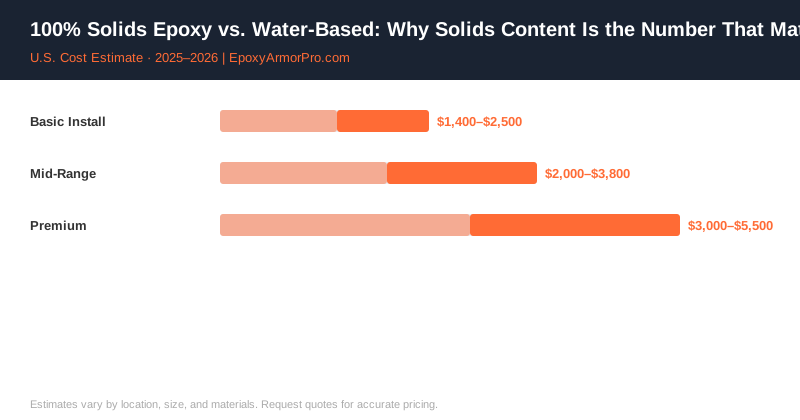
| Pro 100% solids epoxy system | $200–$500 | $4.00–$8.00/sq ft | $1,600–$3,200 |
Over a 15-year period, a $1,600 100% solids install costs $107/year. A $300 DIY water-based coat that needs redoing every 3–4 years costs $75–$100/year — but also costs you two full weekends of labor every few years, plus the knowledge that your floor never quite performs at the level you wanted.
The Decision Framework
Choose water-based epoxy when:
- You’re DIY-ing and this is your first coating project
- The space is light-duty: low traffic, no vehicles, no heavy chemicals
- Budget for materials is under $300 and professional installation isn’t in the plan
- You understand you’re buying 5–7 years, not 15
Choose 100% solids epoxy when:
- Your garage handles vehicles, chemicals, or heavy equipment
- You want a professional result that lasts and is warranted
- You’re hiring an installer and want what they’re using to matter
- You’ve done the total-cost math and understand the 15-year value
For more on what this decision looks like in the context of DIY labor vs. professional installation, the DIY vs. professional epoxy guide walks through the full comparison.
Contractor Referral Disclaimer: EpoxyArmorPro is a contractor referral and cost information service, not a licensed flooring contractor. We connect consumers with independent, licensed, and insured contractors. We do not perform any flooring work directly. Cost estimates are averages based on market data and vary by location, project size, materials, and contractor. Always verify contractor licensing and insurance before hiring. Individual quotes may differ from estimates shown.